Enterprise container security is the build-to-runtime discipline of defending OCI images, Kubernetes clusters, registries, and runtime workloads across a regulated organization. The enterprise scope adds audit-grade compliance evidence, exploit-aware prioritization, and multi-cluster admission control to the standard four-layer model.
This guide explains the architecture, risk domains, compliance considerations, and rollout steps involved in building an enterprise container security program.
Key Takeaways
- Enterprise container security spans the four Kubernetes layers (Code, Container, Cluster, Cloud) plus compliance evidence and exploit-aware prioritization, not just runtime scanning bolted onto a cluster.
- A mature platform should define and consistently meet risk-based remediation timelines for critical, high, and actively exploited vulnerabilities.
- Map every control to NIST SP 800-190 §4.1.1 and §4.3.2, CIS Kubernetes Benchmark v1.8 controls 5.2.x and 5.7.x, and the CISA KEV catalog so compliance evidence comes out of the same pipeline that builds your images.
- A 90-day rollout (baseline CVE inventory → hardened-image pilot → SLA reporting) and a six-metric KPI scorecard (MTTC, CVE-reduction %, exploitable backlog) keep the program reportable at the board level.
What Enterprise Container Security Covers in 2026
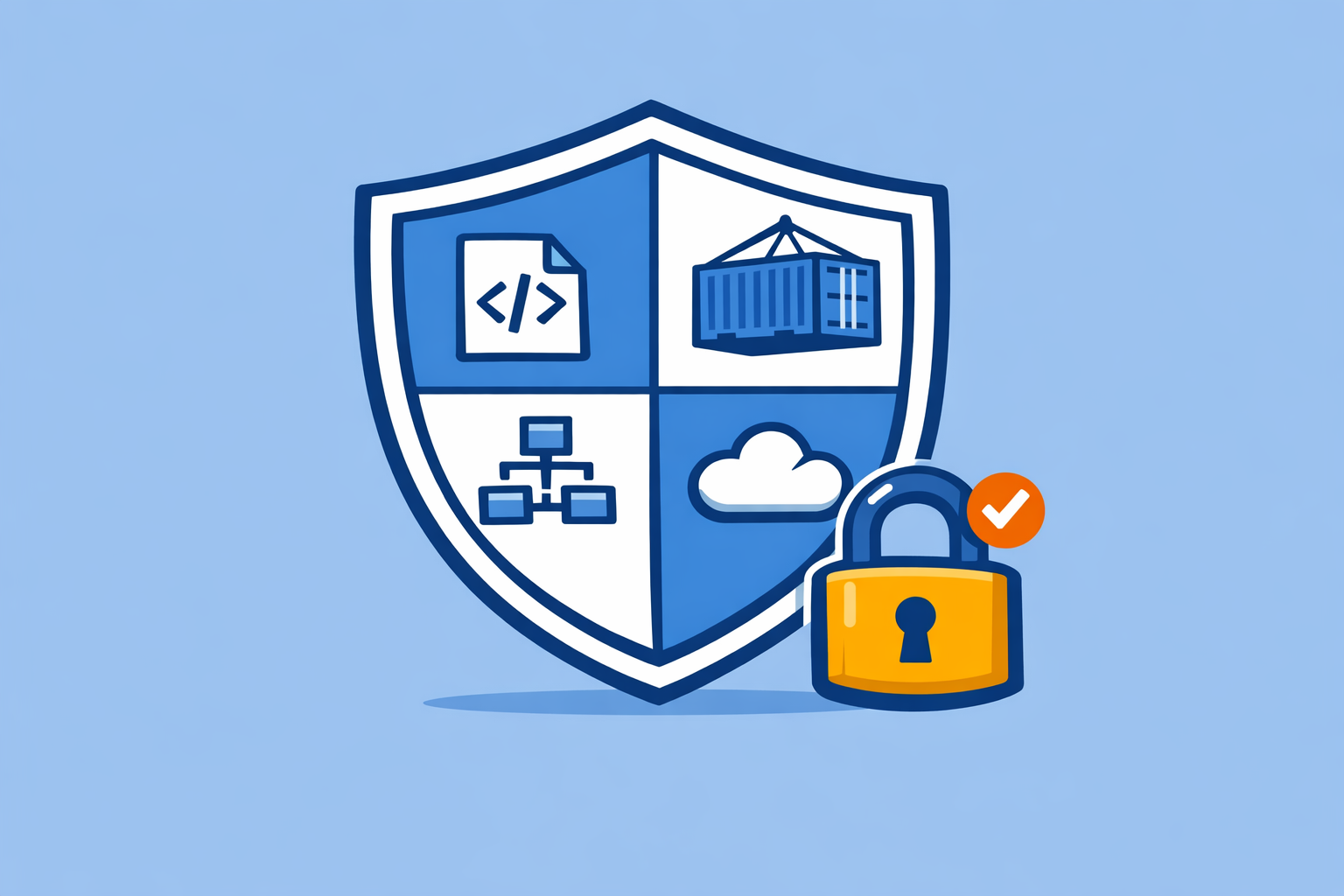
Enterprise container security protects containerized applications across the build, registry, deploy, and runtime stages, with audit evidence, multi-tenant governance, and exploit-aware triage layered on top. The model maps directly to the Kubernetes 4 Cs framework: Code, Container, Cluster, and Cloud.
Definition: Enterprise Container Security in One Sentence
Enterprise container security is a build-to-runtime program combining hardened image supply, Kubernetes admission control, runtime sensing, and continuous compliance evidence under a single governance model. The reference standard is NIST SP 800-190 (Application Container Security Guide, September 2017), which still anchors most federal audits in 2026.
How Enterprise Scope Differs From Team Container Security
A single application team can run a vulnerability scanner and call it done. An enterprise program has to prove controls work across thousands of images, multiple business units, and overlapping audit regimes: FedRAMP, PCI DSS v4.0, NIS2, and DORA. Read the hardened images foundation for the image-layer building block this scope depends on.
Why Enterprise Teams Are Reframing Container Security as a Build-Time Problem
Enterprise teams are moving controls left because runtime scanning cannot keep up with CVE volume. Aqua Security counted 28,000 new CVEs disclosed during 2024. Public base images can inherit a substantial vulnerability backlog through operating-system packages and runtime dependencies. Exact counts vary by image version, scanner, advisory feed, and scan date.
The math gets worse during triage. The timing and volume of newly disclosed vulnerabilities can vary significantly between image families. Smaller, continuously rebuilt images may reduce vulnerability churn and shorten the backlog, but any quantitative comparison should clearly document the image set, scanner, measurement window, and methodology.
The Mean Time to CVE benchmark documents the methodology.
The 2024 Verizon DBIR (Data Breach Investigations Report) attributed 14% of breaches to exploitation of vulnerabilities, the second-largest action vector after credential abuse. Most of those exploits hit unpatched OSS components, exactly the inherited-CVE problem that build-time minimization solves.
The Eight Risk Domains Every Enterprise Container Security Program Must Cover
An enterprise container security program covers eight risk domains, each mapped to a NIST SP 800-190 section, a CIS Kubernetes Benchmark v1.8 control, or a MITRE ATT&CK for Containers technique. Skipping any domain creates an audit gap scanners cannot close.
Image and Base-Layer Risk
Inherited CVEs and unnecessary packages in the base image. NIST SP 800-190 §4.1.2 recommends running only required components; a standard nginx:latest pull in 2026 still ships with many packages the application binary never executes.
Misconfiguration and Kubernetes Posture Risk
Pods with privileged: true, missing Pod Security Standards labels, or wide-open NetworkPolicy. CIS Kubernetes Benchmark v1.8 controls 5.2.2 (no hostPID) and 5.2.5 (no privileged containers) target this domain.
Runtime and Behavioral Risk
Container escape, lateral movement, and cryptomining. CVE-2024-21626 ("Leaky Vessels," CVSSv3 8.6, vector CVSS:3.1/AV:L/AC:H/PR:N/UI:N/S:C/C:H/I:H/A:H) and MITRE ATT&CK for Containers technique T1611 (Escape to Host) describe the canonical attack path.
Supply Chain, Registry, and Provenance Risk
Typosquatting, dependency confusion, and tampered registry artifacts. SLSA (Supply-chain Levels for Software Artifacts) Level 3 build provenance plus a cryptographically signed SBOM (Software Bill of Materials) per image close most of this gap; see the cryptographic SBOM visibility breakdown.
Identity, RBAC, and Admission Risk
Over-privileged ServiceAccounts and unverified images reaching production. Kyverno or OPA Gatekeeper policies that require signed digests cover the admission gap; CIS Kubernetes Benchmark v1.8 §5.1.x covers RBAC posture.
Compliance and Audit-Evidence Risk
Failing FedRAMP, FIPS 140-3 (Federal Information Processing Standard for cryptographic modules), PCI DSS v4.0, NIS2, or DORA evidence requests. NIST SP 800-190 emphasizes maintaining visibility into image contents and vulnerabilities. An SBOM can provide practical supporting evidence for that objective.
Prioritization and Alert-Noise Risk
Triage queues full of non-exploitable CVEs that crowd out the real ones. Combining the CISA KEV catalog, EPSS scores, reachability information, and VEX statements can help teams reduce low-priority noise and focus on vulnerabilities that are more likely to require action.
Lifecycle and Patch-Debt Risk
Stale digests left in production because rebuilding is painful. A continuous source-built pipeline that rebuilds on upstream change keeps the patch-debt curve flat instead of compounding.
Capabilities a 2026 Enterprise Container Security Platform Must Deliver
An enterprise container security program should provide these capabilities through an integrated operating model, whether they come from one platform or a coordinated set of tools.
| Capability |
Why it is mandatory in 2026 |
Anchor |
| Unified build-to-runtime coverage |
Replaces scanner sprawl across the four Kubernetes layers |
4 Cs model |
| Native CI/CD plus admission control |
Blocks unsigned or non-hardened images before they reach a cluster |
CIS K8s 5.2 |
| Exploit-aware prioritization (KEV, EPSS, VEX) |
Cuts triage queues by surfacing actively exploited CVEs first |
CISA KEV |
| Cryptographically signed SBOM and VEX |
Satisfies NIST SP 800-190 §4.1.1 and reduces false positives in scanners |
NIST 800-190 |
| 48-hour SLA for high and critical CVEs |
Caps MTTC at a value most audit programs accept |
Trust Center |
| FIPS 140-3 and STIG (Security Technical Implementation Guide)-aligned images |
Required for federal and DoD boundaries |
NIST FIPS |
| Air-gapped and self-hosted deployment |
Required for classified and regulated workloads |
FedRAMP High |
| Compliance dashboard per control number |
Replaces spreadsheet evidence collection during audits |
NIST 800-190 |
Two capabilities carry the most weight in vendor demos. Exploit-aware prioritization should ship with native VEX exploitability filtering, and FIPS readiness should mean source-built FIPS 140-3 container images, not a wrapper around a non-validated runtime.
The Reference Architecture for Enterprise Container Security
The reference architecture is a five-stage pipeline: source, build, registry, admission, runtime. Each stage has one control plane and one piece of audit evidence. It is the diagram you would draw during a FedRAMP package review.
- Source: hardened upstream base images plus a private image catalog under SLA.
- Build: SLSA Level 3 pipeline that produces a digest, an SBOM, and a Sigstore signature.
- Registry: Artifactory, ACR, or Iron Bank, all keyed by digest with IAM-scoped pulls.
- Admission: Kyverno admission policies that reject unsigned or non-hardened images.
- Runtime: eBPF-based sensor for drift, plus a compliance dashboard reading the same SBOM and VEX feed used at build time.
CIS Kubernetes Benchmark v1.8 §5.2 (admission controllers) and §5.7 (general policies) describe the admission stage in audit language. Every stage emits an artifact that an auditor can subpoena.
CIS, NIST, and CISA Control Mapping for Enterprise Container Security Programs
A defensible enterprise container security program maps every technical control to a specific framework citation. Use the table below as the starting point for an audit matrix; extend it with PCI DSS v4.0 or HIPAA IDs where applicable.
| Domain |
NIST SP 800-190 |
CIS Kubernetes v1.8 |
CISA / MITRE |
| Image minimization |
§4.1.2, §4.3.2 |
5.7.3 |
— |
| SBOM and provenance |
§4.1.1 |
— |
CISA SBOM guidance |
| Admission control |
§4.3.4 |
5.2.2, 5.2.5 |
— |
| Runtime isolation |
§4.4 |
5.2.x |
MITRE T1611 |
| KEV and exploit triage |
§3.4.3 |
— |
CISA KEV catalog |
| Identity and RBAC |
§4.2.4 |
5.1.x |
— |
For the federal mapping detail, see NIST SP 800-190 alignment. The CIS Kubernetes Benchmark v1.8 is authoritative for the cluster controls cited above.
Vendor Evaluation Framework: How to Score Enterprise Container Security Platforms
A defensible vendor evaluation uses weighted criteria, not a feature checklist. Listicle articles ranking "the top 5 container security tools" skip this step. Use the matrix below in a 30-day proof-of-value before committing budget.
| Criterion |
Weight |
What "Strong" looks like |
| Build-to-runtime coverage |
25% |
One platform handles image, registry, admission, runtime, and compliance |
| Exploit-aware prioritization |
25% |
Native KEV plus EPSS plus VEX, not raw CVSS sort |
| Developer workflow |
20% |
Drop-in image swap, no Dockerfile rewrites |
| Enterprise scale |
15% |
Air-gapped install, multi-cluster RBAC, SSO via SAML and OIDC |
| Unified vs point-tool |
15% |
Single dashboard, single SLA, single audit export |
Gartner's Market Guide for Cloud-Native Application Protection Platforms (CNAPP, 2024 update) uses overlapping language; borrow that buyer-criteria phrasing for procurement memos.
Common Procurement Pitfalls and How to Avoid Them
The following procurement pitfalls commonly appear when organizations compare container security platforms.
The first pitfall is assuming a scanner replaces a hardened image program. It does not. If your stock public images ship with 50–60 CVEs and you only buy a scanner, you have funded faster triage, not less risk.
The second pitfall is failing to compare total cost of triage to total cost of prevention. Organizations should compare the recurring cost of triage, exception handling, and rebuild work with the cost of adopting and maintaining a hardened-image program. The result will depend on fleet size, vulnerability volume, automation, and application compatibility.
The third pitfall is multi-registry sprawl. Each additional registry increases governance, access-control, signing, replication, and evidence-management complexity. Organizations should minimize unnecessary registry sprawl and apply consistent admission policies across every approved source. Pick one primary registry and mirror to air-gapped or DoD environments behind it.
A 90-Day Enterprise Container Security Rollout Plan
A 90-day enterprise container security rollout has three phases, each ending in an auditor-reviewable deliverable. The plan assumes a platform team of 3–5 engineers and a security architect.
Days 0–30: Inventory and Baseline
Inventory every image pulled in production over the last 60 days, baseline the CVE count per image, and run a CIS Kubernetes Benchmark v1.8 gap analysis. Output: a CVE heat map and a CIS gap list scoped to controls 5.1.x, 5.2.x, and 5.7.x.
Days 31–60: Hardened Image Pilot and Admission Enforcement
Pick the top 10 highest-CVE images, swap them for hardened equivalents, and roll out Kyverno admission policies in audit mode. Output: a before-and-after CVE delta on the pilot images and an admission audit log of every image that would have been blocked in enforce mode.
Days 61–90: SLA Reporting and Audit Evidence Pack
Cut over admission to enforce mode for the pilot clusters, ship the first MTTC report, and assemble the FedRAMP or PCI evidence pack from the SBOM and VEX feed. Output: an executive dashboard and the first NIST SP 800-190 audit-evidence bundle.
KPIs and Board-Level Reporting for Enterprise Container Security
Board-level reporting on enterprise container security needs six metrics, no more. Each has a one-sentence definition and a target the audit team can hold the program to.
- Mean Time to CVE (MTTC): average days from CVE publication to image-level visibility; target under 7 days for critical findings.
- CVE reduction %: delta between stock public image CVE count and hardened image CVE count per image line; target 90%+.
- Exploitable CVE backlog: open CVEs that intersect the CISA KEV catalog or have EPSS > 0.7; target zero in production.
- Time-to-patch SLA hit rate: percentage of critical CVEs remediated within the contractual SLA window; target 95%+.
- Admission policy violation rate: images blocked or warned per 1,000 deploys; useful as a leading indicator of pipeline drift.
- Audit evidence freshness: days since the last SBOM and VEX export per regulated image line; target under 24 hours.
How Minimus Supports Enterprise Container Security Programs
Minimus is the supply-chain layer of an enterprise container security program. Minimus delivers hardened, minimal container images built continuously from upstream source, with a signed SBOM and Sigstore attestation per digest, a 48-hour SLA on critical and high CVEs, and FIPS 140-3 and STIG-aligned variants for federal and DoD workloads.
The platform pairs the Hardened Image Gallery with Image Creator for private custom images, Compliance Dashboards mapped to CIS, FIPS, and STIG, and air-gapped mirroring to Artifactory, ACR, or Iron Bank. For a deeper walkthrough, read the Minimus platform overview.
Ready to baseline your enterprise CVE count or run the 90-day rollout? Get a demo at https://www.minimus.io/get-a-demo or browse images at https://images.minimus.io.
Frequently Asked Questions
What Is Enterprise Container Security?
Enterprise container security is a build-to-runtime program that protects OCI images, Kubernetes clusters, and registries across a regulated organization, with built-in compliance evidence and exploit-aware vulnerability triage. The reference standard is NIST SP 800-190.
What Are the Components of an Enterprise Container Security Platform?
A 2026 platform has eight components: hardened image supply, SLSA 3 build, signed SBOM per digest, registry with IAM-scoped pulls, admission control via Kyverno or OPA, runtime sensing, KEV/EPSS/VEX prioritization, and a compliance dashboard mapped to NIST SP 800-190 and CIS Kubernetes Benchmark v1.8.
What Is the Difference Between Container Security and Kubernetes Security?
Container security covers the image, build, and registry layers. Kubernetes security covers the cluster, admission, and pod-runtime layers. Enterprise container security covers both, plus the compliance evidence chain that ties them together.
How Does Enterprise Container Security Map to NIST SP 800-190?
NIST SP 800-190 §4.1.1 requires an accurate component inventory (SBOM), §4.1.2 requires image minimization, §4.3.2 requires capability restriction, and §4.3.4 requires admission control. A 2026 platform must export evidence against each section.
Do Enterprises Still Need a Runtime Scanner if They Use Hardened Images?
Yes, but for a narrower job. Hardened images cut build-time CVEs by 95%+, which collapses the scanner queue to exploitable runtime drift, unknown binaries, and misconfiguration findings—the work a runtime tool is actually good at.













.svg)
.svg)




.svg)




.svg)