Use case: NIST SP 800-190

Minimus Images: Achieving Federal Container Security Mandates with NIST SP 800-190 Alignment

See Minimus in action
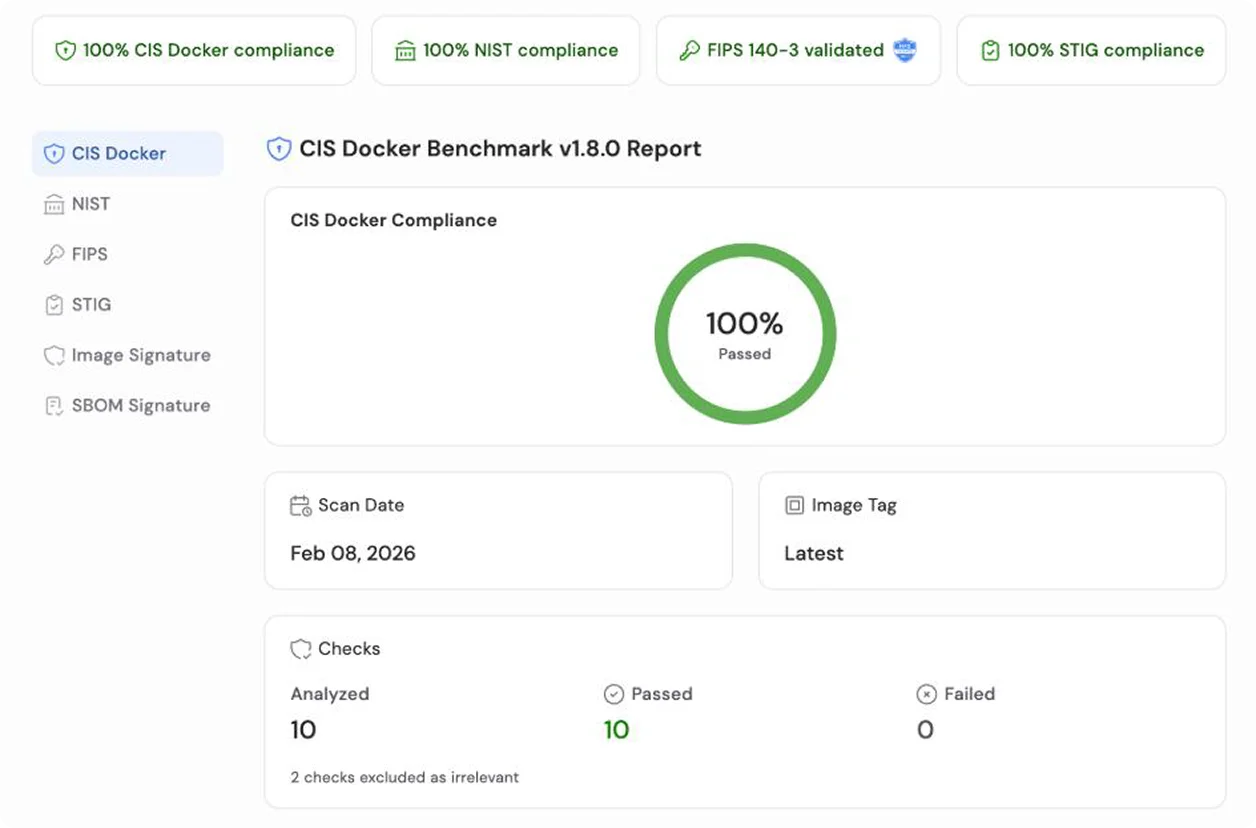
CIS Docker Benchmark Report

Technical Alignment and Value Proposition for High-Security Government Enclaves

Engineering Foundations

Minimus was engineered from the ground up to address the complex security requirements outlined in NIST SP 800-190 (Application Container Security Guide), a foundational guide co-authored by one of the company's founders.

Optimized Images

Our approach delivers a new category of container images that are inherently minimal, cryptographically verifiable, and functionally optimized for critical federal cybersecurity mandates.

Strategic Risk Mitigation

This integration moves beyond standard best practices by focusing on technical mechanisms that dramatically reduce operational risk and accelerate compliance, particularly in restricted environments.

How Minimus Image Architecture Delivers NIST SP 800-190 Compliance Advantages for Government Agencies

Ultra-Minimal Construction for Attack Surface Reduction

Every Minimus image is engineered to eliminate extraneous components, such as shells and non-essential binaries. This drastically reduces the attack surface, directly aligning with the principle of least functionality and minimizing exposure to vulnerability chains.

Cryptographically Verifiable Supply Chain Integrity

All images are built with SLSA compliance principles, featuring cryptographically signed provenance records that are verifiably reproducible from source code to registry. This mitigates supply chain threats, ensures non-repudiation of build artifacts, and satisfies rigorous control objectives for software integrity.

Integrated Threat Intelligence and Automated Action Providers

We embed curated, real-time threat intelligence feeds and built-in action providers that automatically surface precise remediation steps within CI/CD and runtime tooling. This capability significantly accelerates vulnerability detection, patch deployment, and compliance drift correction.

Native Support for Air-Gapped and Self-Hosted Environments

Minimus images are optimized for seamless, secure deployment in air-gapped, classified enclaves, and other disconnected environments. This includes full, verifiable support for offline image mirroring, patch delivery, and policy enforcement without dependence on public cloud connectivity, making it critical for defense and intelligence use cases.

Policy-Aware by Design

Images are configured by default to conform with baseline security standards such as FedRAMP, DoD SRG, and CIS Benchmarks. This pre-hardening minimizes configuration drift and significantly reduces the manual effort required by development and security teams to meet regulatory mandates.

Provable, Per-Build Compliance Reporting

The Minimus image pipeline generates a comprehensive Minimus NIST Report with every image build. This report provides granular compliance evidence against the NIST SP 800-190 Section 3.1 Benchmark, detailing the pass/fail status for every relevant NIST ID and including explanatory notes. This automated, verifiable reporting provides customers with a definitive, auditable compliance artifact, dramatically reducing the burden of manual assurance.

Minimus Images and NIST SP 800-190 Control Alignment

NIST SP 800-190 RECOMMENDATION
HOW MINIMUS IMAGES SUPPORT IT
IMAGE PROVENANCE VERIFICATION (5.1.2)
Minimus implements SLSA L3 compliance, providing signed, non-repudiable attestations to verify the image origin, build process, and source integrity.
USE MINIMAL BASE IMAGES (5.1.4)
Utilizes a distroless-like base, eliminating the shell and package management layer. This removes unnecessary packages and binaries, fulfilling the principle of least privilege in the image itself.
SCAN IMAGES FOR KNOWN VULNERABILITIES (5.1.6
Automated tooling continuously scans images for new CVEs and triggers automated rebuilds and patch delivery, ensuring continuous vulnerability management and system patching.
LIMIT CONTAINER PRIVILEGES (5.3.1)
Images are configured to run as a non-root user by default, lacking shell access (/bin/sh or similar). This configuration enforces a least-privilege security posture at runtime.
PROTECT SECRETS AND SENSITIVE DATA (5.4.1)
The immutable and minimal nature of the images prevents secrets sprawl and ensures that secrets or credentials are never inadvertently baked into the image layer itself.
USE TRUSTED REGISTRIES (5.2.1)
Images are delivered via a private, secure registry that supports traceable updates and verifiable provenance data for integrity checking prior to deployment.
LIFECYCLE MANAGEMENT OF CONTAINERS (5.5.2)
Minimus enforces a strict rebuild and patch delivery cadence to ensure ongoing compliance with lifecycle security requirements, minimizing the window of exposure.
ENFORCE RUNTIME SECURITY CONTROLS (5.3.2)
Images leverage pre-hardened kernel configurations and security profiles, which significantly minimizes the need for complex, post-deployment security tooling.
AUDIT CONTAINER EVENTS (5.6.1)
Complete Software Bills of Materials (SBOMs) and rich metadata are generated for every build, providing full traceability and compliance-friendly audit trails for deployed containers.
COMPLIANCE DOCUMENTATION (3.1)
The Minimus NIST Report provides provable, per-build compliance documentation against Section 3.1, giving auditable evidence for relevant NIST IDs

Secure, minimal container images

Get a demo