Use case: Technology

Enabling Secure, Accelerated Software Delivery with Minimus Images for Modern DevOps

See Minimus in action
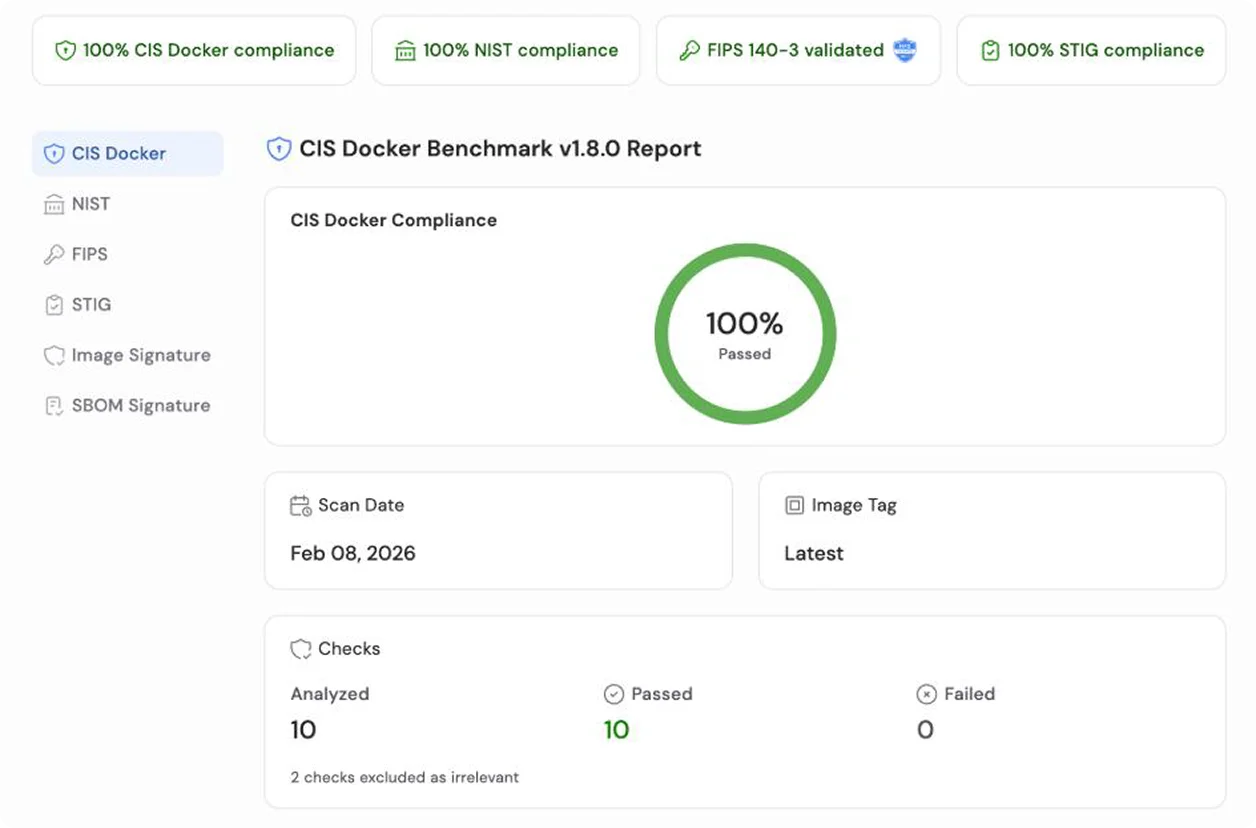
CIS Docker Benchmark Report

Accelerating Secure Software Delivery for Engineering Teams

Balancing DevOps Velocity

Tech organizations utilizing containerized and Kubernetes-based environments must strategically balance development velocity, stringent security requirements, and regulatory compliance.

High-Stakes Industry Risks

This challenge is amplified for firms serving security-sensitive industries such as government (FedRAMP), healthcare (HIPAA), or finance (PCI). Legacy container images, often built on full Linux base layers, introduce a substantial and unnecessary attack surface.

The Minimus Advantage

Minimus fundamentally solves this problem by providing purpose-built, ultra-minimal container images that consistently reduce vulnerability counts by 97% or more compared to common official base images.

Core Advantages of Minimus for Security-Conscious Software Delivery

Minimalist Image Architecture Reduces CVEs by 97%+

Minimus images employ a distroless model, incorporating only the essential runtime dependencies of a specific application. By systematically eliminating non-essential components such as package managers, shells, and compilers, Minimus drastically reduces the attack surface and simplifies the process of achieving image-level compliance with FedRAMP, CIS benchmarks, and NIST SP 800–190.

Threat Intelligence Integration Enables Exploit-Focused Remediation

Minimus enriches standard CVE metadata with integrated threat intelligence from multiple sources such as EPSS and CISA KEV, providing exploitability insights, active campaign indicators, and real-world threat signals. This capability allows security teams to move beyond static severity scores and prioritize image updates based on the genuine likelihood of exploitation, optimizing patch workflows and aligning with NIST 800–190 and the SSDF.

Developer-Centric Automation via Native Action Providers

Minimus seamlessly integrates into modern CI/CD and security response pipelines through native action providers. Out-of-the-box support includes GitHub Actions, Slack, webhooks, and email. This policy-driven automation, such as triggering rebuilds on high-risk advisories, reduces friction between engineering and security for rapid software delivery cycles.

Offline-Ready and Self-Hostable for FedRAMP and Sovereign Deployments

Minimus images are engineered for use in fully disconnected, classified, or highly restricted environments, removing reliance on public registries or cloud APIs. Regulated enterprises, government agencies, and the tech orgs that support them can self-host all Minimus images, to support zero-trust and air-gapped Kubernetes clusters, satisfying critical controls such as SC-12 and SC-28 in FedRAMP and NIST 800–53.

Robust Supply Chain Integrity and Provenance

Every image is built via a reproducible pipeline and includes a cryptographically signed Software Bill of Materials (SBOM). These core features meet key supply chain integrity requirements from frameworks like SLSA and FedRAMP SA–11(2). Supply chain protection features for Node and Python provide granular guardrails for package installation based on factors like age and download reputation.

Enterprise-Grade Customization and Maintenance with Image Creator

The Minimus Image Creator offers a powerful platform for technology customers to define private, bespoke images with custom packages, files, and environment variables. Minimus manages the entire lifecycle of these private images, including daily rebuilds, vulnerability fixes, comprehensive reports, and advisory notifications, simplifying operations and reducing the maintenance burden on internal teams.

Ecosystem Integration and Security Validation

Minimus ensures seamless integration with the cloud-native security ecosystem. Native support is available from key vulnerability scanners including Wiz, Orca, AWS Inspector, Snyk, Trivy, and Grype. Minimus offers a gallery of fully signed, advanced Helm Charts (e.g., for etcd, Keycloak, PostgreSQL, and External-DNS including FIPS versions) for accelerated, secure application deployment.

Mapping Minimus to Key Security Control Frameworks

CONTROL OBJECTIVE
STANDARD / FRAMEWORK
HOW MINIMUS IMAGES HELP
REDUCE VULNERABILITY EXPOSURE IN CONTAINERS
NIST SP 800–190 §4.1, CIS DOCKER BENCHMARK §4.X
Ultra-minimal images exclude unnecessary software, typically reducing CVE exposure by 97%+ while aligning with container hardening best practices.
PRIORITIZE AND REMEDIATE HIGH-RISK VULNERABILITIES
NIST 800–40, FEDRAMP RA-5(2), CNCF SUPPLY CHAIN WHITEPAPER
Integrated threat intelligence, including the enhanced Exploitability Threat Intel feature, enables risk-based remediation based on real-world exploitability. Compliance reports for NIST-800-190, CIS, and STIG assists in reporting and verification.
AUTOMATE SECURITY CONTROLS IN CI/CD
NIST SSDF PW.5.1, FEDRAMP CA-7(1), OWASP DEVSECOPS MATURITY
Action providers automate response workflows using GitHub Actions, Slack, webhooks and Email to enforce policy-driven automation.
ENSURE INTEGRITY OF SYSTEMS AND SOFTWARE
SLSA LEVEL 2+, FEDRAMP SA-11(2), NIST SP 800–53 SI-7(1)
All images are signed and reproducibly built with attached SBOMs. The Image Compliance Tab provides Cosign commands for verification. The Supply Chain Protection for Python and Node helps protect against supply chain poisoning attacks.
DEPLOY SECURELY IN RESTRICTED AND OFFLINE ENVIRONMENTS
FEDRAMP SC-12, SC-28(1), KUBERNETES HARDENING GUIDE §3.1
Minimus supports fully self-hosted registries and offline-compatible deployment pipelines, ideal for sovereign cloud, classified, or SCIF environments.

Secure, minimal container images

Get a demo