Use case: FedRAMP

Enhancing FedRAMP® Compliance with Minimus Container Images

See Minimus in action
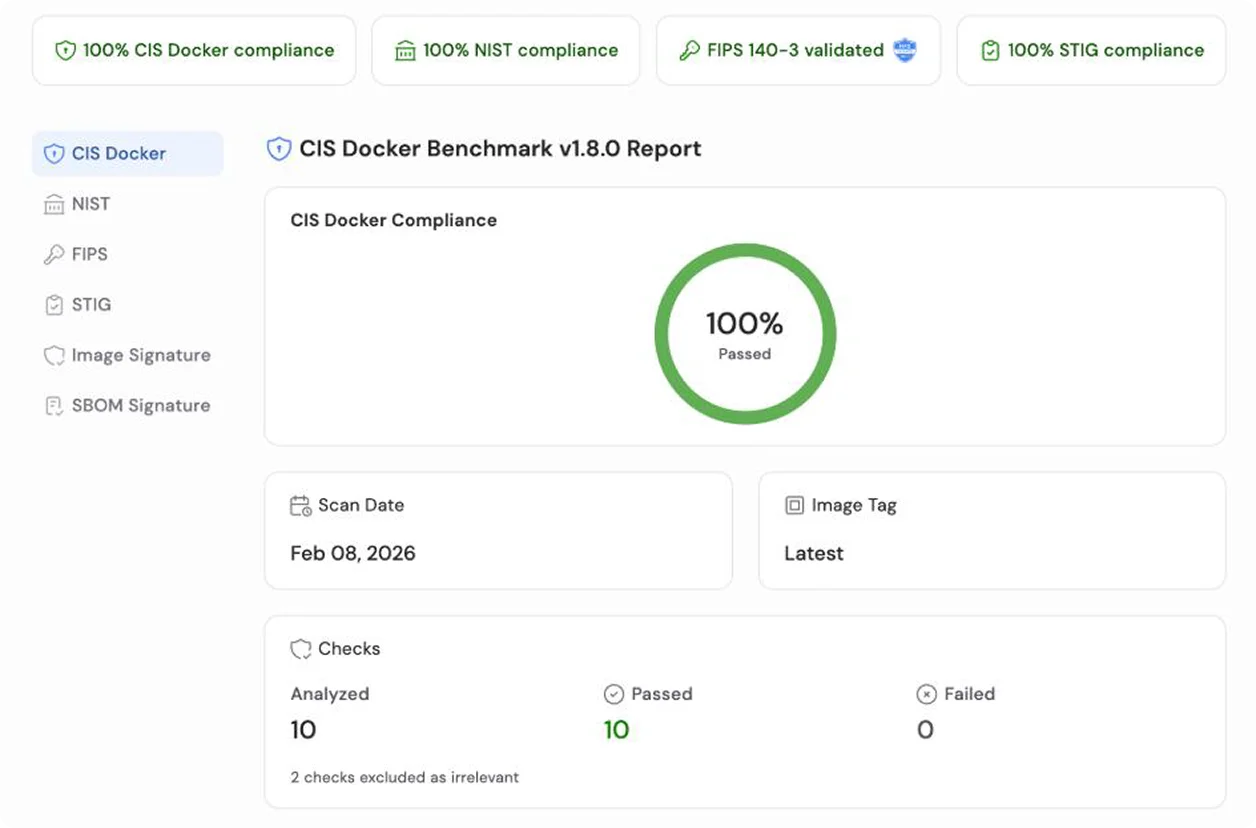
CIS Docker Benchmark Report

The Federal Risk and Authorization Management Program FedRAMP®

FedRAMP Security Standards

The Federal Risk and Authorization Management Program (FedRAMP) establishes stringent requirements for cloud service providers and contractors supporting U.S. federal agencies, particularly around system integrity, vulnerability management, configuration baselines, and secure DevOps.

Minimized Attack Surface

Minimus container images are designed to align directly with these objectives. Built from scratch with only essential components, Minimus images reduce vulnerability exposure by 97% or more compared to common base images.

Built for Compliance

This hardened baseline, combined with integrated threat intelligence for CVE prioritization, support for automated remediation via action providers (e.g., Slack, GitHub Actions, and webhooks), native scanner support (e.g., AWS Inspector, Snyk, Trivy, Grype), and full compatibility with self-hosted and air-gapped environments, makes Minimus a powerful enabler for FedRAMP-compliant containerized workloads.

Key Capabilities Supporting FedRAMP® Security Requirements

Significantly Reduced Vulnerability Surface Area

Minimus images include only what’s required for the target workload, eliminating unnecessary libraries and binaries. This minimal design results in a 97%+ reduction in known vulnerabilities (CVEs) compared to official images, simplifying compliance with FedRAMP vulnerability scanning and patch management requirements.

Integrated Threat Intelligence for Prioritized Remediation

Minimus incorporates real-time threat intelligence into vulnerability metadata, allowing teams to identify and patch high-impact, actively exploited vulnerabilities first—directly supporting FedRAMP requirements for timely and risk-based vulnerability mitigation. The new Image Compliance Tab offers a single point of reference for vulnerability verification and audit readiness.

Automation and Integrated Monitoring

Native support for action providers allows automated alerts, patch workflows, and policy enforcement via commonly used ops tools like Slack, GitHub Actions, and custom webhooks. This enables continuous monitoring and automated response in alignment with FedRAMP continuous monitoring (ConMon) controls. Additionally, native support for popular vulnerability scanners (AWS Inspector, Snyk, Trivy, and Grype) with automatic false-positive filtering simplifies the security assessment process.

Air-Gapped and Self-Hosted Deployments

Minimus supports full operation in disconnected, air-gapped, and classified environments—ensuring agencies and contractors can maintain container security and update processes without relying on external registries or internet access, in compliance with FedRAMP Moderate and High baselines.

Reproducible, Verifiable Builds with Enhanced Supply Chain Controls

Each Minimus image is built using reproducible methods and includes verifiable provenance, digital signatures, and Software Bills of Materials (SBOMs). This ensures full supply chain transparency and supports integrity verification and auditability as required under FedRAMP. New Supply Chain Protection features allow users to set guardrails (age, reputation) when installing packages, and the Image Creator simplifies building and maintaining custom, compliant images with a robust package incompatibility handler.

NIST SP 800-190 Compliance Reporting

Minimus provides a dedicated report aligned with the key security considerations outlined in NIST SP 800-190, Application Container Security Guide (specifically Section 3.1 on Secure Container Image Creation). This single-pane-of-glass report aggregates data on image provenance, vulnerability status, and configuration, dramatically simplifying the process of demonstrating compliance and audit readiness to assessors.

Mapping Minimus Capabilities to FedRAMP® Controls

CONTROL OBJECTIVE
FEDRAMP REQUIREMENT (NIST 800–53 REV. 5)
HOW MINIMUS HELP
REDUCE VULNERABILITIES TO ACCEPTABLE LEVELS
RA-5(2), SI-2, CM-2(2), CM-3, CM-4
Minimal images eliminate unnecessary components, cutting CVEs by 97%+ and simplifying secure baselining.
PRIORITIZE REMEDIATION & CONTINUOUS MONITORING
RA-5(9), CA-7, SI-2(2)
Threat intelligence integration supports risk-based patching and continuous vulnerability prioritization. Native scanner support simplifies continuous monitoring.
SUPPORT AUTOMATED SECURITY RESPONSE
IR-4(1), IR-5, CA-7(1), CP-9
Action providers (Slack, Email, GitHub Actions) trigger real-time alerts and remediation actions, supporting automated incident response and system recovery.
ENABLE SECURE OPERATIONS IN DISCONNECTED ENVIRONMENTS
SC-12, SC-13, SC-28(1)
Fully self-hostable and air-gap capable; no external dependencies required for image storage or updates.
ENSURE INTEGRITY AND SUPPLY CHAIN TRANSPARENCY
SI-7(1), CM-6(1), SA-11(2), SR-3, SA-10
Reproducible builds, signed images, and SBOMs ensure verifiability. Supply Chain Protection features and the Image Creator enhance control over components and configuration.
ENHANCE AUDITABILITY & COMPLIANCE REPORTING
CA-7, SA-11, SI-2, AU-2, AU-6
The NIST SP 800-190 and STIG compliance reports and detailed change log for each build provide single-point visibility for audit readiness and verification of secure image creation processes.
SECURE BASELINE CONFIGURATION MANAGEMENT (NEW)
CM-2, CM-3, CM-4, SA-3
Image Creator simplifies building and maintaining custom, compliant images with optional customer provided files like certificates and config files, enforcing secure configuration baselines.

Secure, minimal container images

Get a demo