Use case: Healthcare

Minimus Images Help Healthcare Organizations Meet HIPAA Security and Compliance Objectives

See Minimus in action
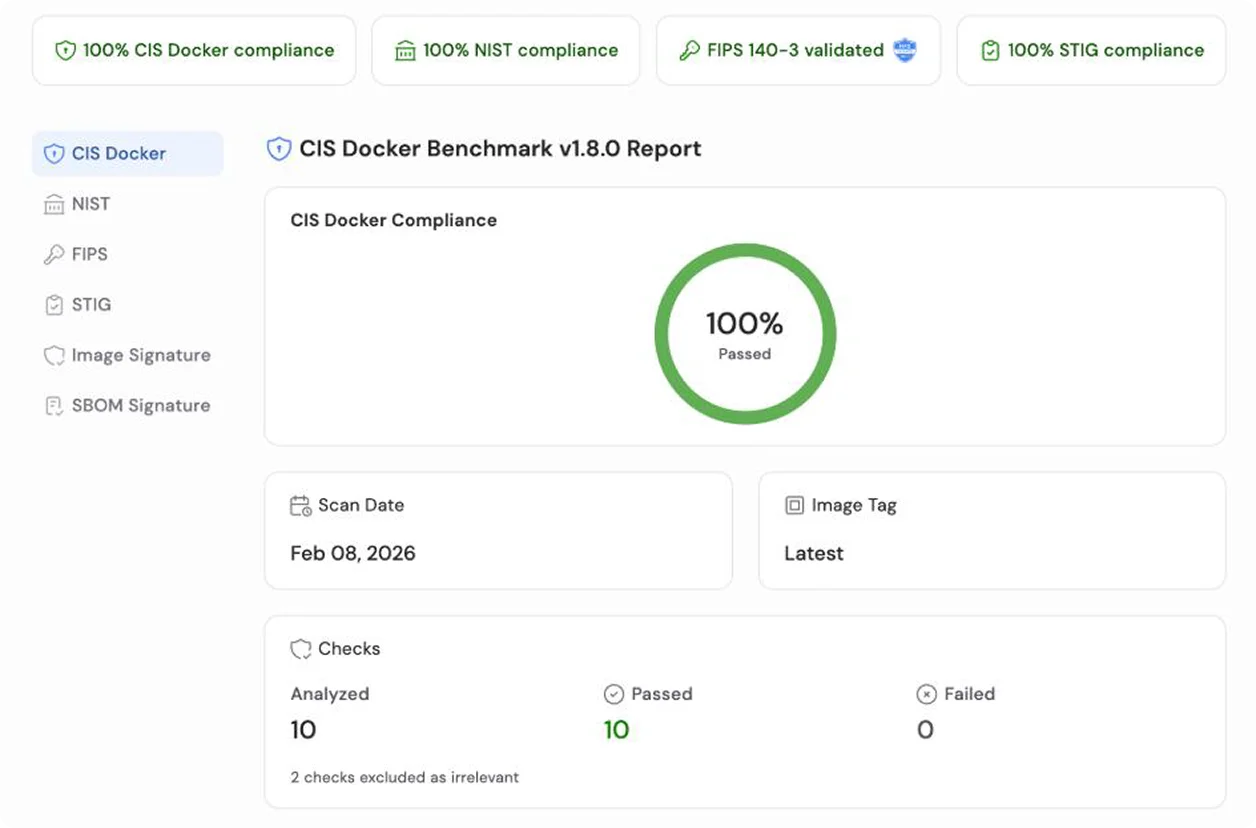
CIS Docker Benchmark Report

Reducing Vulnerabilities and Strengthening Compliance with Secure Container Images

Healthcare Security Obstacles

Healthcare organizations face unique challenges in securing sensitive patient data while maintaining compliance with strict frameworks like HIPAA and the NIST Cybersecurity Framework.

Minimus Images

Minimus images - minimal, secure-by-default container images, offer a critical foundation for reducing vulnerabilities, ensuring software supply chain integrity, and streamlining compliance with technical safeguards in the healthcare sector.

Securing Governance Goals

Their use supports multiple HIPAA control objectives by providing verifiable provenance, reducing attack surfaces, and enabling continuous governance.

Key Advantages Supporting Healthcare Security Requirements

Secure Software Supply Chain

Minimus images are built with verifiable provenance metadata (SLSA-compliant) and come with Software Bills of Materials (SBOMs) for full transparency. This helps healthcare organizations verify the origin and integrity of the software, which aligns with HIPAA’s requirement to protect against unauthorized access or tampering. This process is now augmented with Supply Chain Protection features that enable security guardrails based on age or download reputation when installing packages (e.g., Python, Node), further mitigating the risk of incorporating compromised components.

Reduced Attack Surface

These images are minimal, containing only the essential components needed to run the application, which drastically reduces the potential attack surface. For healthcare environments, this minimizes the risk of exploitation and supports the HIPAA Security Rule’s mandate to protect ePHI against reasonably anticipated threats.

Continuous Vulnerability Management

Minimus continuously monitors for vulnerabilities and rebuilds images as soon as a fix is available, ensuring systems handling electronic protected health information (ePHI) remain current and secure. This capability is enhanced by integration with a wide array of third-party scanners (Grype, Trivy, etc.) while accurately filtering out false positives.

Auditable and Compliant Defaults

All Minimus images enforce built-in security defaults (non-root users, no shell access, etc.) and cryptographically verifiable provenance. The Image Compliance Tab provides a single, central reference point for key compliance metrics, including CIS Docker Benchmarks, FIPS 140-2 validation, NIST-800-190 alignment, and STIG verification. These compliance reports for every image build streamlines documentation and evidence for audits and assessments, helping organizations demonstrate compliance during assessments.

Improved Incident Response and Recovery

With deterministic builds and tight integration with CI/CD pipelines, Minimus images support rapid rollback and recovery in the event of a breach or security incident. This aligns with HIPAA’s requirements around ensuring system integrity and availability during and after an incident, reducing Mean Time to Recovery (MTTR).

Alignment with Industry Security Control Objectives

HIPAA/NIST CONTROL OBJECTIVE
HOW MINIMUS IMAGES HELP
NEW: NIST 800-190 SEC 3.1 (CONTAINER SECURITY)
A dedicated NIST Compliance Report for this section provides streamlined, documented evidence for container-specific security controls.
ACCESS CONTROL (HIPAA: 164.312(A)(1) / NIST: PR.AC-1)
Minimus images enforce secure defaults (non-root users, no shell), limiting unauthorized access to the running container environment and ePHI.
AUDIT CONTROLS (HIPAA: 164.312(B) / NIST: DE.CM-7)
SBOMs, signed provenance, and the Image Compliance Tab provide detailed, auditable, and tamper-proof logs for compliance reviews.
INTEGRITY CONTROLS (HIPAA: 164.312(c)(1) / NIST:
Verifiable build pipelines and tamper-proof images protect system integrity. Supply Chain Protection guardrails prevent the introduction of vulnerable packages.
RISK ANALYSIS/MANAGEMENT (HIPAA: 164.308(A)(1)(II)(A) / NIST: ID.RA-1)
Minimus’s continuous vulnerability tracking, threat intelligence, and OpenVEX support continuous risk analysis and mitigation strategies for ePHI.
CONTIGENCY PLAN (HIPAA: 164.308(A)(7)(II)(A) / NIST: PR.IP-9)
Deterministic builds support rapid, verifiable recovery, reducing downtime and system unavailability during a failure or incident.
ACTIVITY REVIEW (HIPAA: 164.308(A)(1)(IIV)(D) / NIST: DE.CM-1)
Continuous updates and monitoring, augmented by the Image Compliance Tab, ensure system activity is consistently reviewed and within compliance boundaries.

Secure, minimal container images

Get a demo