Minimus is ending operations. We appreciate the support of our many customers globally and are proud to have served you. Unfortunately, the current business and investment climate has resulted in a situation in which we are unable to continue operations. We acknowledge the effort that transitioning from our images will require and we are committed to providing customers with a stable transition period.
Beginning on Monday 24 August 2026, we will begin a 60 day maintenance period for the product and images. During this period, we will make necessary bug fixes to the overall product, provide commercial support, and continue to maintain images with upstream updates. On Thursday 22 October 2026, we will cease operations and turn off the Minimus registry (reg.mini.dev). Images pulled from the registry prior to 22 October will, of course, continue to function, but no further updated images will be provided.
For Enterprise Edition customers, we are committed to ensuring a fair and orderly conclusion to our commercial relationships. We will reach out to each Enterprise Edition customer individually, beginning on 24 August, to discuss the structured termination of your agreement, including any applicable refunds for the remaining contract period beyond 22 October.
While this is not the outcome that any of us wanted, we hope that this approach provides customers with ample opportunity to smoothly transition.
When a new vulnerability is disclosed, several things must happen before it is resolved in a container image:
A vulnerability is published in a security advisory or vulnerability database.
A fix becomes available in the affected package or dependency.
The container image maintainer rebuilds the image with the patched dependency.
A new image version or digest is published for users to pull.
Mean Time to Remediation measures the time between step one and step four. In other words, it measures how long users remain exposed to a vulnerability after it becomes publicly known.
This is why MTTR is an important metric alongside CVE counts and MTTC: it helps security teams understand how quickly vulnerabilities actually disappear from the images they deploy.
Why MTTR is Shortened in Minimus Container Images
In traditional container image ecosystems, these steps to remediation can take weeks or months. Image maintainers may wait for upstream distribution releases, bundle multiple changes into infrequent rebuilds, or prioritize other updates before shipping patched images. Upstream distributions such as Debian and Alpine generally choose to delay updates that fix lower-severity vulnerabilities until the next major release (which may be six months to two years away).
Minimal image pipelines that build all packages from source code are designed to shorten this window. Because the packages are updated as soon as the upstream project fixes the vulnerability, and because rebuilds are automated and frequent, fixes can be incorporated and published much faster.
How to Calculate MTTR
An image’s MTTR is calculated by generating every SBOM across an image line and examining the first version of an image that contains a fixed package. For public images, this means identifying the last vulnerable image and finding the next release as fixed. In practice, this is straightforward because public image maintainers typically publish a new version for each update, allowing you to compare sequential releases such as 1.1.5, 1.1.6, and 1.2.0.
For Minimus images, the process is slightly different. Rather than relying on version bumps, Minimus continuously releases updated digests for the same version as fixes become available. This means there may be multiple releases of the same version of the hardened container image (for example, several 1.1.5 digests), each incorporating additional CVE fixes over time. MTTR is therefore calculated by identifying the earliest image version that contains the fixed version found in the advisories digest.
Calculating Public Nginx Image MTTR
Let’s dive into MTTR by examining the nginx web server image:
First, we generate an SBOM for each of the past 50 versions of the nginx image’s main version line (i.e. 1.21.3 but not 1.21.3-debian).
We load each of these and their corresponding vulnerabilities into a database.
Then, for each vulnerability, we identify the most recent image version it affects, discarding vulnerabilities still present in the present image version.
After finding the last vulnerable version, we examine the following release (by push date) as the first fixed version of the image.
Example Public Image MTTR Calculation: CVE-2022-23308
High severity vulnerability CVE-2022-23308 was published on 2022-02-26. This CVE was resolved in the 1.21.6 release of the image on 2022-05-29. We subtract the CVE’s published date from the push date of the fixed image, 2022-05-29 and 2022-02-26, giving a time difference of 92 days.
These times are averaged together to give the final MTTR of 277 days.
(Of course, higher risk vulnerabilities tend to be fixed more quickly; filtering out low and medium severity CVEs leads to a much lower MTTR of 185 days.)
Calculating Minimus Postgres Image MTTR
The process for calculating Minimus images’ MTTR is analogous but slightly different.
Again, we generate SBOMS for each of the past 50 digests of the Minimus postgres main image line.
Often, a single image version will have multiple digests with vulnerable packages being updated in different digests. Each image version and its library versions are inserted into the database.
Then, for every library version that corresponds to a CVE’s fixed version in the Minimus SecDB advisory feed, we consider the first digest that contains that library as the first fixed version (unless the oldest digest contains that fixed version).
As with the public image, the vulnerability’s published date is subtracted from the digest’s pushed date to give a time to remediation.
Example Minimus MTTR Calculation
The Minimus digest lists gosu version 1.17-r4 as containing a fix for CVE-2025-22874. On 2025-06-16, Minimus released new digests for postgres version 17.5 (as well as 16.9, 15.13, and other versions major versions) upgrading the package.
With the CVE’s published date of 2025-06-11, this gives a time to remediation of 4 days. Averaging across all vulnerabilities that have been fixed in Minimus postgres digests gives an MTTR of 15 days.
MTTR Comparison Across Images
To make these differences more concrete, the table below compares MTTR across representative public and Minimus images.
Image
Public Image MTTR
Minimus Image MTTR
Reduction
nginx
281 days
2 days
~99% faster
node
53 days
22 days
~58% faster
redis
249 days
14 days
~94% faster
postgres
267 days
13 days
~95% faster
python
94 days
14 days
~85% faster
Across these images, the gap is consistent: public images measure remediation in months, while Minimus reduces that window to days, delivering dramatically faster remediation and more predictable timelines.
This is particularly notable when combined with the increase in MTTC for these images. For example, in the nginx image, the public Docker Hub image sees a new CVE about every 4 days while the Minimus nginx image sees a new CVE about every 33 days, and those CVEs are remediated 99% faster in the Minimus image when they do occur.
That’s a powerful combination that allows organizations to focus more on running nginx and less on patching it…and, when a fix is needed, to deliver it to production much faster.
Interpreting MTTR: Adjusting for Outliers
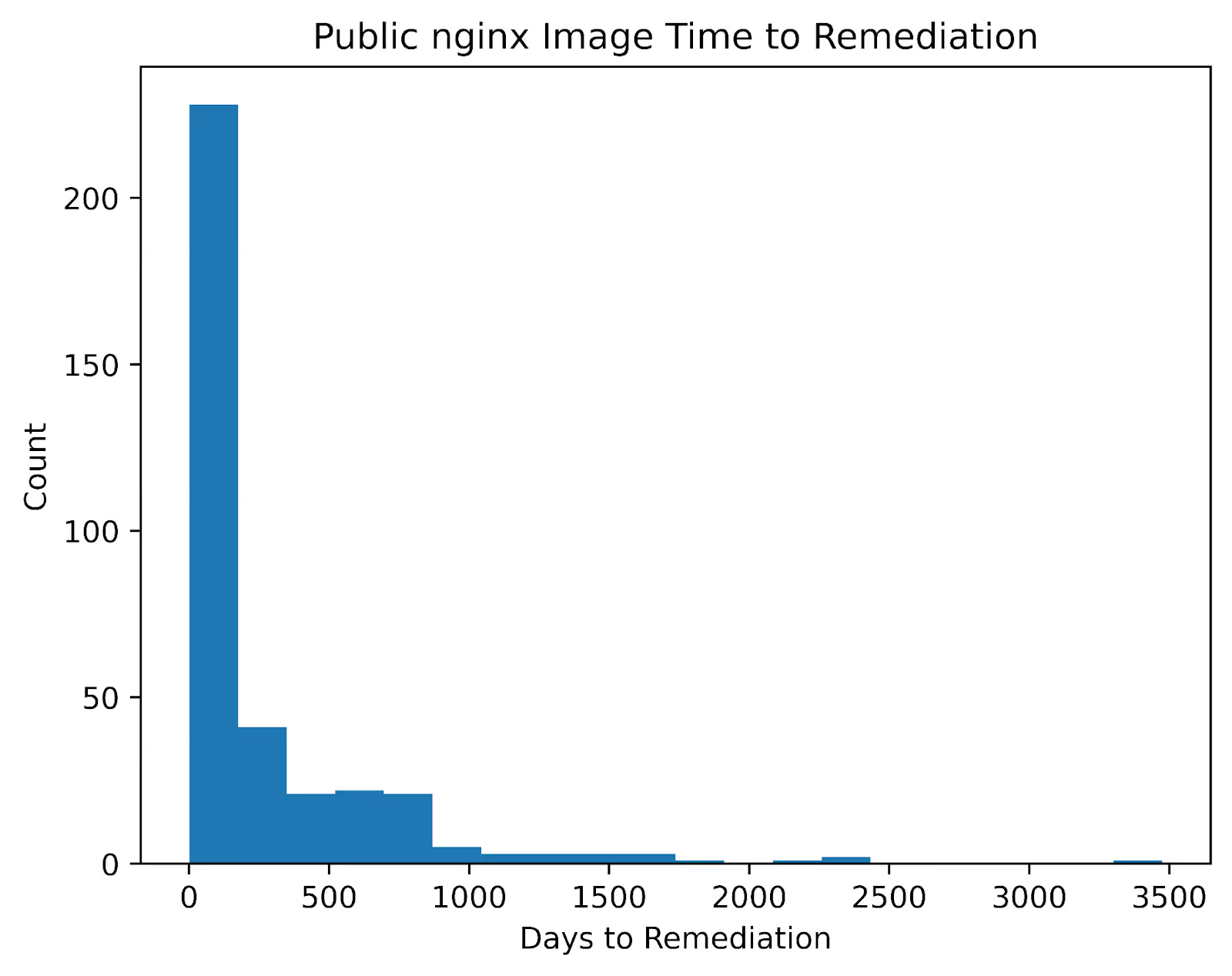
It’s important to understand how MTTR behaves as a metric. In real-world datasets, remediation times are not evenly distributed. A small number of vulnerabilities can remain unpatched for extremely long periods, which skews the average upward.
We can examine the mean time to remediation of the public nginx image graphically. The distribution below demonstrates how a few outliers drive the average remediation time up.
The most extreme example, CVE-2013-0340, was present in nginx 1.25.0 and prior versions, but not in 1.25.1. Its published date of 2014-01-21 subtracted from nginx 1.25.1’s release date of 2023-06-13 gives a time to remediation of over nine years.
There are only 17 vulnerabilities with a TTR of over 1000 days, and dropping them from the calculation brings the MTTR down from 277 days to 205. The median time to remediation is only 119 days, less than half of the mean, which better reflects the typical remediation experience.
Even adjusting for outliers, you can see that public image remediation is both slow and inconsistent. While some vulnerabilities are fixed relatively quickly, others persist for years, making it difficult for security teams to rely on predictable remediation timelines.
Public Nginx Image Days to Remediation
Why Mean Time to Remediation Matters for Container Image Security
Mean Time to Remediation (MTTR) offers another lens for evaluating the security of hardened container images. Public images often take months, sometimes even years, to address known issues, leaving organizations exposed for extended periods. In contrast, Minimus hardened container images demonstrate much faster MTTR, with fixes landing in days rather than months.
For security teams, this means that using Minimus hardened container images doesn’t just reduce the number of vulnerabilities and the frequency of new ones, it also ensures that when issues arise, they’re resolved far more rapidly. Taken together, MTTC and MTTR highlight a complete picture of why minimal images deliver stronger, more predictable security outcomes compared to public images.














.svg)
.svg)




.svg)




.svg)