Minimus is ending operations. We appreciate the support of our many customers globally and are proud to have served you. Unfortunately, the current business and investment climate has resulted in a situation in which we are unable to continue operations. We acknowledge the effort that transitioning from our images will require and we are committed to providing customers with a stable transition period.
Beginning on Monday 24 August 2026, we will begin a 60 day maintenance period for the product and images. During this period, we will make necessary bug fixes to the overall product, provide commercial support, and continue to maintain images with upstream updates. On Thursday 22 October 2026, we will cease operations and turn off the Minimus registry (reg.mini.dev). Images pulled from the registry prior to 22 October will, of course, continue to function, but no further updated images will be provided.
For Enterprise Edition customers, we are committed to ensuring a fair and orderly conclusion to our commercial relationships. We will reach out to each Enterprise Edition customer individually, beginning on 24 August, to discuss the structured termination of your agreement, including any applicable refunds for the remaining contract period beyond 22 October.
While this is not the outcome that any of us wanted, we hope that this approach provides customers with ample opportunity to smoothly transition.
EU Cyber Resilience Act: What It Means for Teams Running Container-Based Software
By
Ori Ron
May 21, 2026
Engineering teams don't struggle to find CVEs in their container images. The harder challenge is maintaining a clean image standard without it becoming a full-time job. The EU Cyber Resilience Act is now making that challenge a legal requirement, not just a best practice.
The CRA is Europe's first mandatory cybersecurity law for digital products. It entered into force on December 10, 2024, with reporting obligations beginning September 11, 2026, and full enforcement on December 11, 2027. It sets baseline security requirements for any software or hardware product placed on the EU market, and it holds the manufacturer (the entity that builds and distributes the product) responsible for maintaining that security throughout the product's life.
For engineering and security teams building containerized software, the law's requirements land in a familiar place: the image layer.
Cyber Resilience Act EU - What is it?
The Cyber Resilience Act (Regulation (EU) 2024/2847) entered into force in December 2024. It addresses a specific problem: too many software products reach end users carrying known vulnerabilities, with no clear obligation on the manufacturer to fix them. The CRA changes that by making security a legal requirement, not just a best practice.
The regulation applies a lifecycle model. It does not just require security at ship time, it requires manufacturers to patch vulnerabilities, issue updates, and respond to incidents throughout a product's supported life.
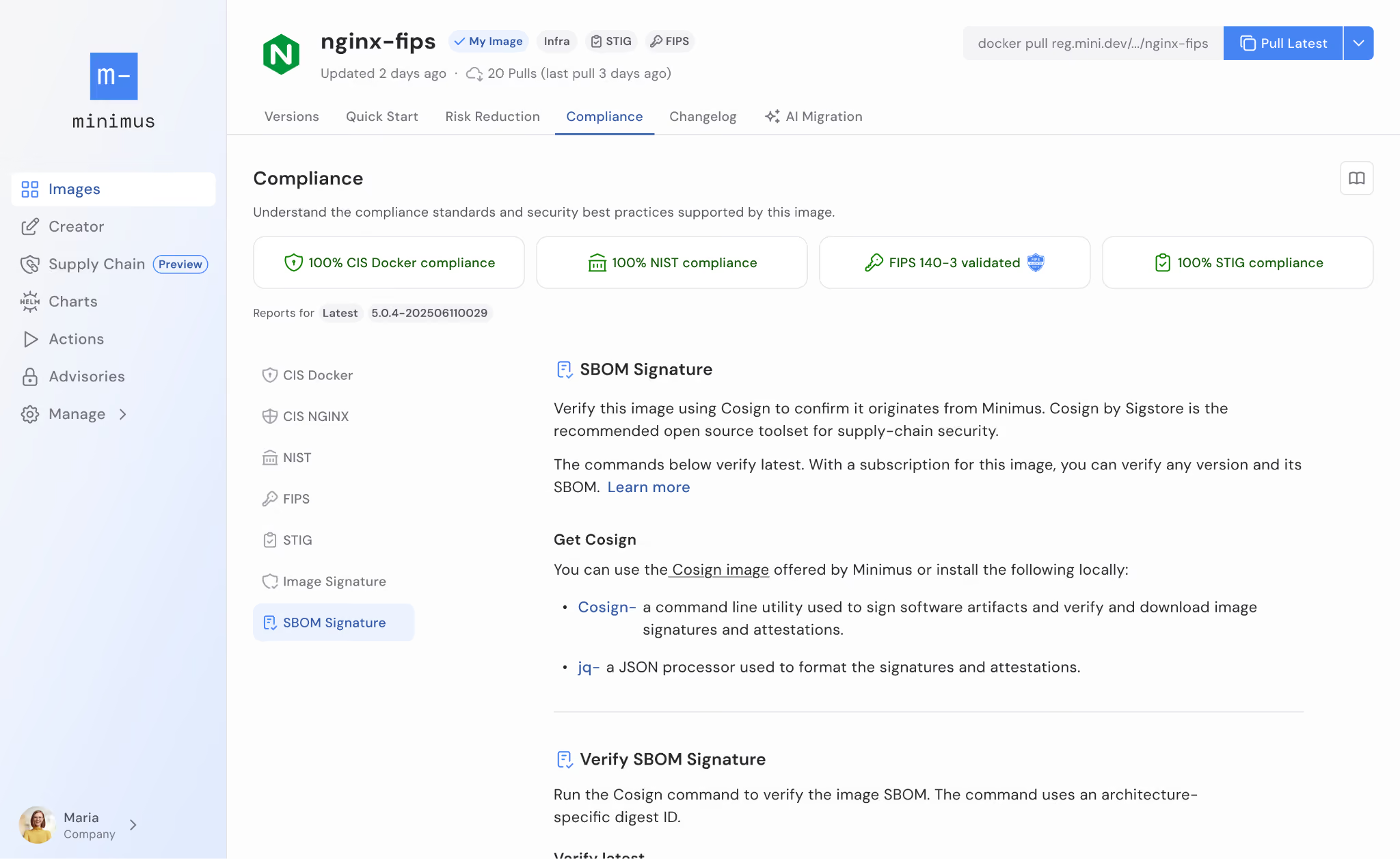
Minimus SBOM Signature compliance check for nginx
Does the CRA apply to you?
The CRA has explicit extraterritorial reach. What determines scope is not where your company is incorporated - it is whether customers receive, download, or deploy your software in their own environments. If you distribute containerized software to EU customers, you're already in scope, as the regulation applies to products with digital elements that are intended for or reasonably foreseeable to have network or device connectivity and are placed on the EU market.
Why does this matter if you build software on container images?
Your containerized products are likely in scope. When you ship software that runs on container images, the security posture of those images is part of the security posture of your product. A base image carrying known vulnerabilities is a known vulnerability in your product.
Sourcing from a provider whose image maintenance model is built around these exact requirements, clean at release, patched continuously, fully documented, is the most direct way to reduce your compliance exposure at the foundation.
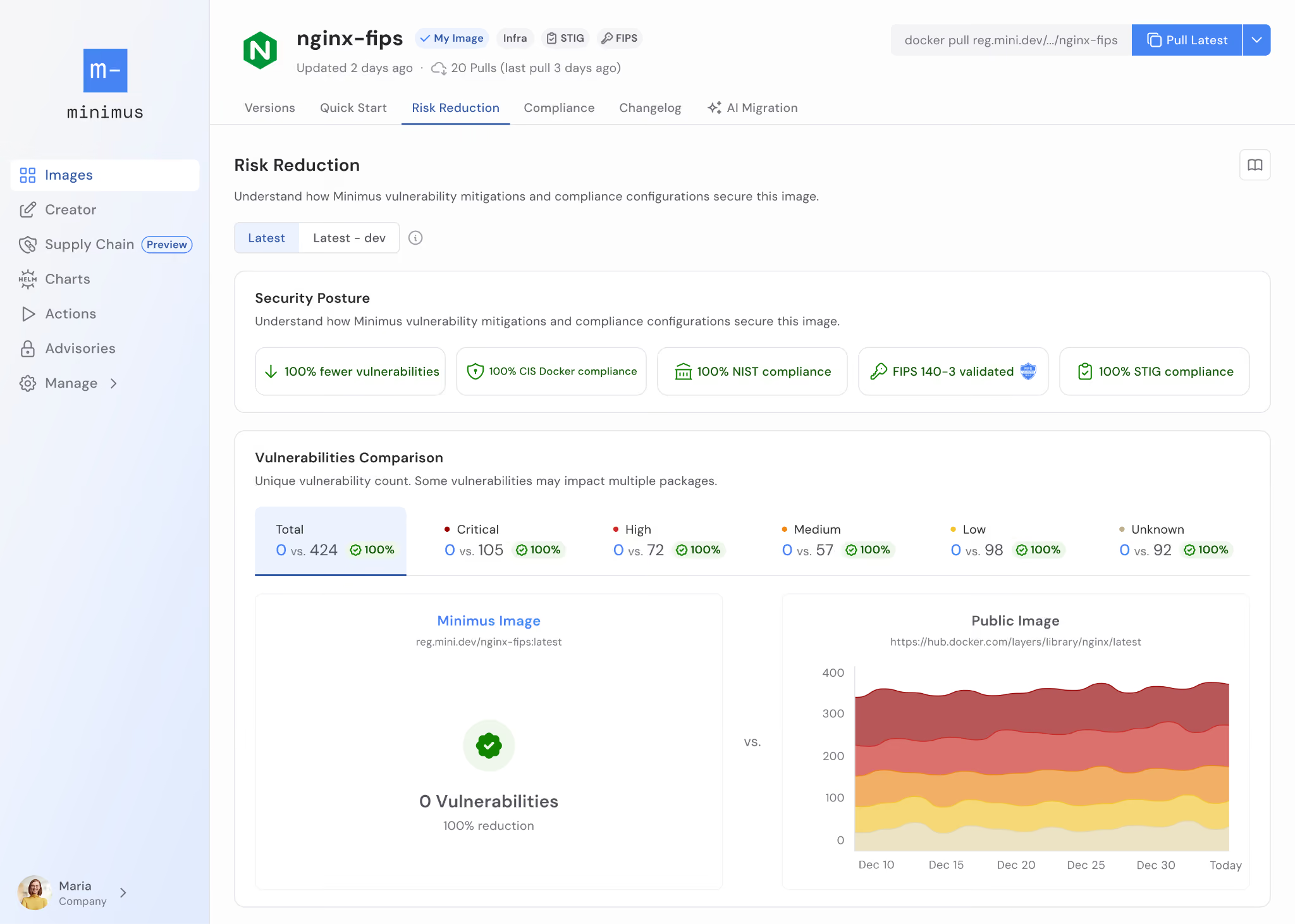
nginx: 0 vulnerabilities with Minimus vs public image
EU Cyber Resilience Act SBOM Requirements
One of the core obligations under the EU Cyber Resilience Act SBOM requirement is the provision of a Software Bill of Materials. Manufacturers must supply a machine-readable inventory of vulnerabilities and components in a commonly used format that covers at least the top-level dependencies of the products with digital elements. This documentation must be continuously updated. It is a regulatory requirement that enables identification of vulnerabilities across the supply chain.
For containerized software, a compliant SBOM must cover at least the top-level dependencies. Minimus goes further: our SBOMs simply contain everything in your image. This comprehensive approach gives you greater visibility into your supply chain and stronger evidence of compliance than the regulation's minimum requires.
How Minimus hardened container images map to CRA requirements
Minimus builds secure, minimal container images designed to reduce attack surface and keep CVE counts low for teams that need to move fast without compromising on security or compliance. Minimus's service model is built around the same security properties the CRA requires, so teams using Minimus images are starting from a foundation that already addresses several of those obligations by design, rather than having to build that compliance posture from scratch.
Minimus Hardened Images vs. Standard Container Images
How Minimus addresses EU Cyber Resilience Act compliance obligations by design:
CRA Compliance Requirement
What It Means
Minimus
Standard Container Images
No known vulnerabilities at time of shipping
Software reaches EU customers free of known CVEs, the CRA’s most fundamental product security requirement.
✔
✘
Minimal attack surface
Only packages required for the workload are included, with no shells, compilers, or unused utilities.
✔
✘
Secure default configuration
Hardened security settings are applied at build time, not dependent on customers configuring correctly.
✔
✘
Software Bill of Materials (SBOM)
Machine-readable component inventory for every image, enabling vulnerability tracking and compliance evidence.
✔
✘
Continuous security patching
Vulnerabilities are addressed and remediated without undue delay.
✔
✘
Free security updates
Security patches and updated images are made available to active Minimus customers at no additional cost.
✔
✘
Customer notification of available updates
When a patched version is available, Minimus customers receive an update and can inform their affected customers.
✔
✘
Every Minimus image ships with:
Zero known exploitable CVEs at time of release.
A machine-readable SBOM covering all components.
Hardened security defaults applied at build time.
Continuous patch coverage for the active subscription lifetime.
The Bottom Line
The CRA doesn't ask whether you have a security process. It asks whether the software your customers run is clean, and whether it stays clean. Those are questions that begin with the image.
Most of the CRA's core product requirements describe behaviors that are already built into how Minimus maintains images: clean at release, minimal by design, continuously patched, and fully documented. For teams navigating CRA compliance, starting at the image layer isn't just practical, it addresses the requirements with the highest technical specificity.
Learn More About Minimus
Our images are built with only what is needed, patched continuously, and maintained so that teams spend less time chasing vulnerabilities and more time shipping software. They integrate cleanly into existing CI/CD pipelines without adding operational overhead.
This post is for general informational purposes only and does not constitute legal advice. If you're unsure whether your specific products fall within scope, we recommend speaking with qualified legal counsel.













.svg)
.svg)




.svg)


.svg)