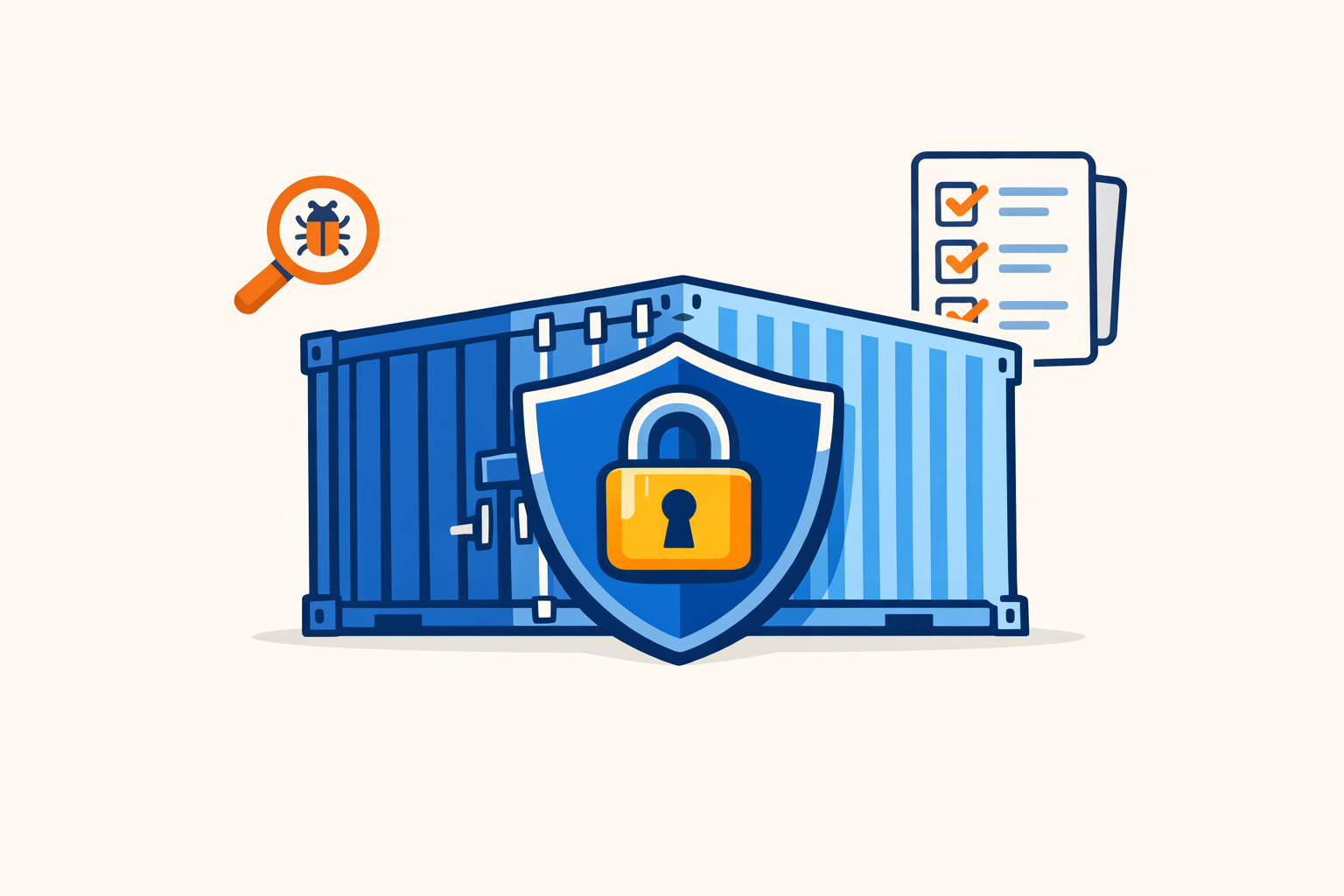
This buyer's checklist scores 18 specific container security features for cloud workloads on three practitioner criteria: protection-gap severity, cloud-platform fit, and compliance footprint. The structure is vendor-neutral and capability-led, with one evaluation question per feature.
This guide presents a capability-led checklist for evaluating container security across build, supply chain, admission, runtime, and compliance workflows. The features below reflect what survives the renewal call, not what wins the demo.
Key Takeaways
- The best container security features for cloud workloads in 2026 split into five categories: build-time hardening, supply-chain integrity, admission enforcement, runtime detection, and compliance evidence. A vendor that wins on one but fails another will not survive a regulated audit.
- Build-time features are the most underweighted category in vendor pitches. Public base images may contain inherited vulnerability findings from operating-system and runtime packages. The number varies by image tag, architecture, package set, scanner, advisory feed, and scan date, NIST SP 800-190 section 4.1.1.
- Cryptographic supply-chain features (signed SBOMs, image signing, Supply-chain Levels for Software Artifacts (SLSA) Level 3+ provenance) gate whether software ships into FedRAMP, DoD Impact Level 5, the Network and Information Security Directive 2 (NIS2), or the Digital Operational Resilience Act (DORA) scopes.
- Runtime features look identical in demos and diverge at scale. eBPF overhead, escape detection mapped to MITRE ATT&CK for Containers, and Kubernetes-aware drift detection are the differentiators that matter on a 30-day pilot.
What "Container Security Features for Cloud" Should Mean to a Buyer
Container security features for cloud workloads are the discrete technical controls that detect, prevent, or eliminate vulnerabilities, policy violations, and runtime threats in containerized workloads on Kubernetes (EKS, AKS, GKE, OpenShift), serverless container runtimes (Fargate, Cloud Run, Azure Container Apps), and air-gapped self-hosted clusters.
Treat every feature as a capability lens, not a vendor lens. A capability lens lists what the feature does, what protection gap it closes, and what evaluation question the buyer asks. A "runtime detection" line on one vendor's pitch can mean eBPF syscall monitoring with low p99 overhead; the same line on another can mean that runtime overhead varies by kernel, workload, enabled rules, event volume, and sensor configuration. Measure CPU, memory, event loss, and application latency under representative steady-state and burst conditions during the pilot.
How This Checklist of Cloud Container Security Features Was Scored
Each feature was scored on three criteria: severity of the protection gap, cloud-platform fit, and compliance footprint. Severity asks whether the feature closes a control gap an auditor will ask about, or a marketing gap a vendor invented. Cloud-platform fit asks whether the feature works on AWS, Azure, GCP, on-prem, and air-gapped clusters, or only the vendor's preferred platform. Compliance footprint asks whether the feature maps to a named control in CIS Kubernetes Benchmark v1.8, NIST SP 800-190, NIST SSDF (SP 800-218), PCI-DSS v4, NIS2, or DORA. A feature scores high only when all three are met for the buyer's actual environment.
The 18-Feature Checklist for Cloud Container Security
The table below maps each feature to its category, the protection gap it closes, and the single question a buyer should ask a vendor during a pilot.
| # |
Feature |
Category |
Protection Gap |
Evaluation Question |
| 1 |
Hardened minimal base images |
Build-time |
Inherited base-image CVEs |
Median CVE count per image at first build? |
| 2 |
Reproducible source builds |
Build-time |
Tampered or stale build inputs |
Rebuild on every upstream release? |
| 3 |
Signed SBOM (CycloneDX or SPDX) |
Build-time |
Unknown software inventory |
Signed per digest with Cosign or notation v2? |
| 4 |
Published VEX per CVE |
Build-time |
Exploitability noise |
Published per release or only on request? |
| 5 |
FIPS 140-3 validated crypto modules |
Build-time |
Federal crypto disqualification |
Certificate live on the NIST CMVP list? |
| 6 |
Image signing (Cosign, notation v2) |
Supply chain |
Image tampering in transit |
Verification fails closed at admission? |
| 7 |
SLSA Level 3+ provenance |
Supply chain |
Compromised build pipelines |
In-toto attestations published per image? |
| 8 |
Tag immutability and digest pinning |
Supply chain |
Silent tag mutation |
Tags immutable at the registry layer? |
| 9 |
Air-gapped or self-hosted deployment |
Supply chain |
Outbound dependency for IL5 |
Runs with zero outbound traffic? |
| 10 |
Pod Security Admission enforcement |
Admission |
Privileged pod admission |
Restricted profile cluster-wide by default? |
| 11 |
Policy-as-code (Kyverno, OPA Gatekeeper) |
Admission |
Drift between policy and config |
Policies authored as version-controlled code? |
| 12 |
Signature verification at admission |
Admission |
Unsigned image admission |
Admission rejects unsigned images? |
| 13 |
Default-deny network policies |
Admission |
Lateral movement post-compromise |
NetworkPolicies default-deny per namespace? |
| 14 |
eBPF-based syscall monitoring |
Runtime |
Kernel-module overhead |
Documented p99 overhead per node? |
| 15 |
Kubernetes-aware drift detection |
Runtime |
Image swap, capability change |
Drift at pod spec layer, not just host? |
| 16 |
Container escape detection |
Runtime |
T1611 escape to host |
Detections mapped to ATT&CK technique IDs? |
| 17 |
Threat intelligence (KEV, EPSS) |
Runtime |
CVSS-only prioritization |
Findings enriched with KEV and EPSS? |
| 18 |
Compliance dashboard with control mapping |
Compliance |
Manual evidence collection |
Export passes a Big-Four auditor as-is? |
Build-Time Container Security Features for Cloud
Build-time features are the prevention layer. A program that buys runtime detection but ships standard public base images re-alerts on the same 50 to 80 inherited CVEs every scan cycle, a pattern documented under NIST SP 800-190 section 4.1.1.
Hardened Minimal Base Images
A hardened minimal base image strips out shell utilities, package managers, and other non-runtime components. Per the hardened container images foundation explainer, minimal images cut post-compromise tooling availability even after a container escape.
Reproducible Builds From Upstream Sources
Reproducible source builds are the SSDF (NIST SP 800-218) recommendation for build provenance. Does the vendor rebuild on every upstream release, or once a quarter on a marketing schedule? The two cadences are not comparable.
Cryptographically Signed SBOM and VEX
A Software Bill of Materials (SBOM) lists every package at build time. A Vulnerability Exploitability eXchange (VEX) document declares which CVEs are exploitable in context. SBOM and VEX artifacts should be associated unambiguously with the relevant image digest and protected against unauthorized modification. Signing is one strong way to provide integrity and provenance, but the required evidence format depends on the organization’s assurance model.
FIPS 140-3 Validated Cryptographic Modules
U.S. federal systems using cryptography to protect sensitive information generally must use appropriately validated cryptographic modules. Buyers should verify the module certificate, approved operating environment, configuration, and applicability to the specific system. The validation must appear on the NIST Cryptographic Module Validation Program (CMVP) list under the exact module name. "FIPS-ready" labels are not the same as a live certificate.
Registry and Supply-Chain Container Security Features for Cloud
Supply-chain features close the gap between build and deploy. A signed image with an unverified signature at admission is the same as an unsigned image, and an SLSA Level 3 attestation no consuming cluster reads is paperwork.
Image Signing and Verification
Cosign and Notation are two commonly used approaches for signing OCI artifacts, but buyers should evaluate their trust model, key management, transparency-log requirements, and verification support.
Does the cluster verify the signature at admission, fail closed on a mismatch, and log the decision to a tamper-resistant audit store?
Provenance Attestations (SLSA Level 3+)
SLSA Level 3 requires hardened builds, source-to-build authentication, and tamper-resistant provenance. In-toto attestations at this level let the consuming team trace every image back to a specific source commit.
Tag Immutability and Digest Pinning
Mutable tags are the most common silent failure in container deployments. A registry that lets :latest reassign without notice breaks reproducibility on every redeploy. Enforce immutability at the registry layer and pin pod specs to digests.
Air-Gapped and Self-Hosted Deployment
Air-gapped support is the gating feature for FedRAMP High, DoD Impact Level 5, and many DORA scopes. Can the platform pass an audit with zero outbound traffic from the cluster, registry, and management plane?
Admission and Policy Container Security Features for Cloud
Admission control is the deploy-time gate. A pod that admits without policy review runs whatever it carried in.
Pod Security Admission Profile Enforcement
Kubernetes Pod Security Standards define three profiles: privileged, baseline, and restricted. Evaluate the restricted Pod Security Standards profile as the preferred baseline, then document exceptions for workloads that require additional privileges.
Policy-as-Code Engines
Kyverno and OPA Gatekeeper are Cloud Native Computing Foundation (CNCF) projects for declarative admission policy. Policy-as-code lets the security team version and ship rules through the same pipeline as application code. See the Kyverno minimal-image enforcement guide.
Signature Verification at Admission
A signed image that admits without verification gives no security guarantee. Cosign and notation v2 both ship with Kyverno admission integrations that fail closed on a verification miss.
Default-Deny Network Policies
A namespace without a NetworkPolicy admits east-west traffic from every other namespace by default. Default-deny NetworkPolicies and explicit egress allowlists limit blast radius after a single-pod compromise.
Runtime Container Security Features for Cloud
Runtime features detect what slipped past build and admission. The four below differentiate products that survive a 30-day pilot from the ones that look identical on a data sheet.
eBPF-Based Syscall Monitoring
eBPF probes attach to the kernel without a loadable kernel module. Documented p99 CPU overhead per node should sit at low single digits. Vendors that report only "average" overhead are hiding the autoscaling spike behavior the buyer will see during an incident.
Kubernetes-Aware Drift Detection
A pod admitted with image nginx@sha256:abc running nginx@sha256:def ninety seconds later is drift, and detection must work at the pod spec layer, not just on the host. For per-image CVE tracking that pairs with drift signals, see track and prioritize CVE intelligence.
Container Escape Detection (MITRE ATT&CK)
MITRE ATT&CK for Containers lists technique T1611 (Escape to Host) and related techniques. A detection that fires "container escape attempt" without mapping to a specific technique ID is not actionable.
Real-Time Threat Intelligence (CISA KEV, EPSS)
CISA's Known Exploited Vulnerabilities (KEV) catalog lists CVEs under active exploitation, and the Exploit Prediction Scoring System (EPSS) estimates exploitation probability over the next 30 days. Runtime tools that prioritize on CVSS base score alone over-alert on vulnerabilities no one is exploiting.
Compliance and Audit-Evidence Features for Cloud
Compliance features turn detections into auditor-acceptable evidence. A control without a mapped finding is a control without proof.
Framework Mapping to Named Controls
NIST SP 800-190 section 4.1.1 requires accurate inventory of software components in container images, and CIS Kubernetes Benchmark v1.8 control 5.2.6 prohibits admitting containers with CAP_SYS_ADMIN. The platform's compliance view must cite the exact control number, not the framework name.
One-Click Compliance Dashboards
Dashboards per framework (FedRAMP, PCI-DSS v4, Security Technical Implementation Guide (STIG), DORA, NIS2) reduce manual evidence collection on quarterly attestations. See the compliance dashboards for CIS, FIPS, and STIG post for example output.
Exportable Evidence Packs
The export must pass a Big-Four auditor without rework. A PDF with screenshots is not evidence; a signed JSON or CSV with control IDs, image digests, and detection timestamps is.
Operational and Developer-Experience Features for Cloud
Operational features decide whether the platform gets adopted or shelf-wares. They score whether the team can ship the tool into production without a six-month re-architecture.
Drop-In Image Substitution
Drop-in substitution means swapping a base image with a single line change in the Dockerfile or deployment manifest, with no behavioral changes to the application. If it requires a Dockerfile rewrite, the migration cost compounds across every service.
48-Hour SLA on Critical CVEs
A vendor that publishes a 48-hour SLA on critical CVE remediation for maintained images, with the wording in the contract rather than on the marketing page, is materially different from "best effort." Verify the SLA appears in the master services agreement.
CI/CD-Native Plugins and RBAC Granularity
GitHub Actions, GitLab CI, Argo, and Jenkins plugins cut build-pipeline friction. Activity logs with per-action Role-Based Access Control (RBAC) reduce audit-trail collection time when an auditor asks who approved which image promotion.
The Cloud-Platform Fit Checklist
Cloud-platform fit decides whether the same features work on the buyer's actual environment. The table below summarizes the service hooks that gate native integration on each platform.
| Cloud |
Registry |
Kubernetes |
Serverless Container |
Critical Integration Hook |
| AWS |
ECR |
EKS |
Fargate |
Image scan on push, IAM Roles for Service Accounts |
| Azure |
ACR |
AKS |
ACA, ACI |
Defender for Containers, Workload Identity |
| GCP |
Artifact Registry |
GKE |
Cloud Run |
Binary Authorization, Workload Identity Federation |
| On-prem / air-gapped |
Harbor, JFrog Artifactory |
OpenShift, Rancher, vanilla |
n/a |
Self-hosted mirror, offline policy bundle |
Multi-cloud buyers need the same feature set, evidence export, and policy bundle across every environment. Vendors that ship feature parity on AWS but a different one on GCP are a 12-month integration project the buyer did not budget.
Features That Look Great in Demos but Fail at Scale
I have watched three feature claims play out on a renewal call after looking unbeatable in the original pilot. Each is a pattern to flag before signing.
"Auto-Remediation" That Is a PR Bot Suggestion
Auto-remediation that opens a pull request with a suggested patch is useful. Auto-remediation that ships the patch into production without a human approver is rare in regulated environments and frequently disabled within 90 days of go-live.
"Zero CVE" Without Published SBOM or VEX
A "zero CVE" claim with no published SBOM, no published VEX, and no continuous rebuild cadence is a snapshot, not a guarantee. The CVE count is whatever the vendor's scanner saw on screenshot day.
Runtime-Only Solutions Without Build-Time Prevention
A runtime sensor on a cluster running standard public base images detects the exploit attempt and alerts, but it does not remove the 50 to 80 inherited CVEs that produced the attack surface. Runtime detection and build-time prevention are complementary, not interchangeable.
How Minimus Delivers the Highest-Impact Features on This Checklist
Minimus provides hardened container images and supporting supply-chain artifacts intended to reduce unnecessary packages and inherited vulnerability findings. Its Trust Center states that critical CVEs are patched within 48 hours of upstream fix availability, with separate timelines for high and medium findings. Before publication, verify the exact SBOM, VEX, signature, provenance, Image Creator, FIPS, dashboard, and contractual SLA claims. Any CVE-reduction percentage should be labeled as vendor-reported and accompanied by a reproducible comparison methodology.
Image Creator lets teams build private custom images on the same minimal base when the public catalog does not cover a specific runtime configuration, with Minimus maintaining those images under the same SLA. Minimus images address the build-time, supply-chain, and compliance categories of this checklist, including features 1 through 9 and the framework-mapped compliance dashboard at feature 18. For FIPS-validated coverage, see the FIPS 140-3 in container images walkthrough.
Browse the catalog at images.minimus.io or read the verification, SBOM, and admission-policy guides at docs.minimus.io.
FAQ on Cloud Container Security Features
What Are the Most Important Container Security Features for Cloud Workloads in 2026?
The most important container security features for cloud workloads in 2026 are hardened minimal base images, signed SBOM and VEX documents, signature verification at admission, eBPF runtime monitoring with MITRE ATT&CK mapping, and compliance dashboards with framework control IDs. A vendor that delivers all five at audit quality is the shortlist.
Which Container Security Features Do Buyers Most Often Miss?
Build-time prevention features (hardened images, signed SBOM, FIPS 140-3 validation, reproducible source builds) are the most underweighted on vendor pitches because they sit upstream of the management plane. Buyers shopping on runtime alerting alone pay for a tool that re-alerts on the same inherited CVEs every scan cycle.
How Do I Evaluate Cloud Container Security Features Without Falling for Demo-Day Theater?
Score each feature on three criteria: protection-gap severity, cloud-platform fit, and compliance footprint with named control numbers. Run the pilot on a workload that matches the actual production environment, including autoscaling load and at least one regulated namespace.
Are FIPS-Validated Container Security Features Necessary for Commercial Workloads?
FIPS validates cryptographic modules, not container images or general “features”. For commercial workloads, FIPS is often a contractual requirement passed down from federal prime contractors to commercial subcontractors. Verify the contract clause before assuming FIPS is optional.
What Does "Drop-In Image Substitution" Mean as a Feature?
Drop-in image substitution is the ability to replace a base image with a hardened equivalent through a single line change in the Dockerfile or deployment manifest, with no behavioral changes to the application. The feature scores high only when validated against the buyer's real application stack, not the vendor's demo image list.












.svg)
.svg)



.svg)


.svg)