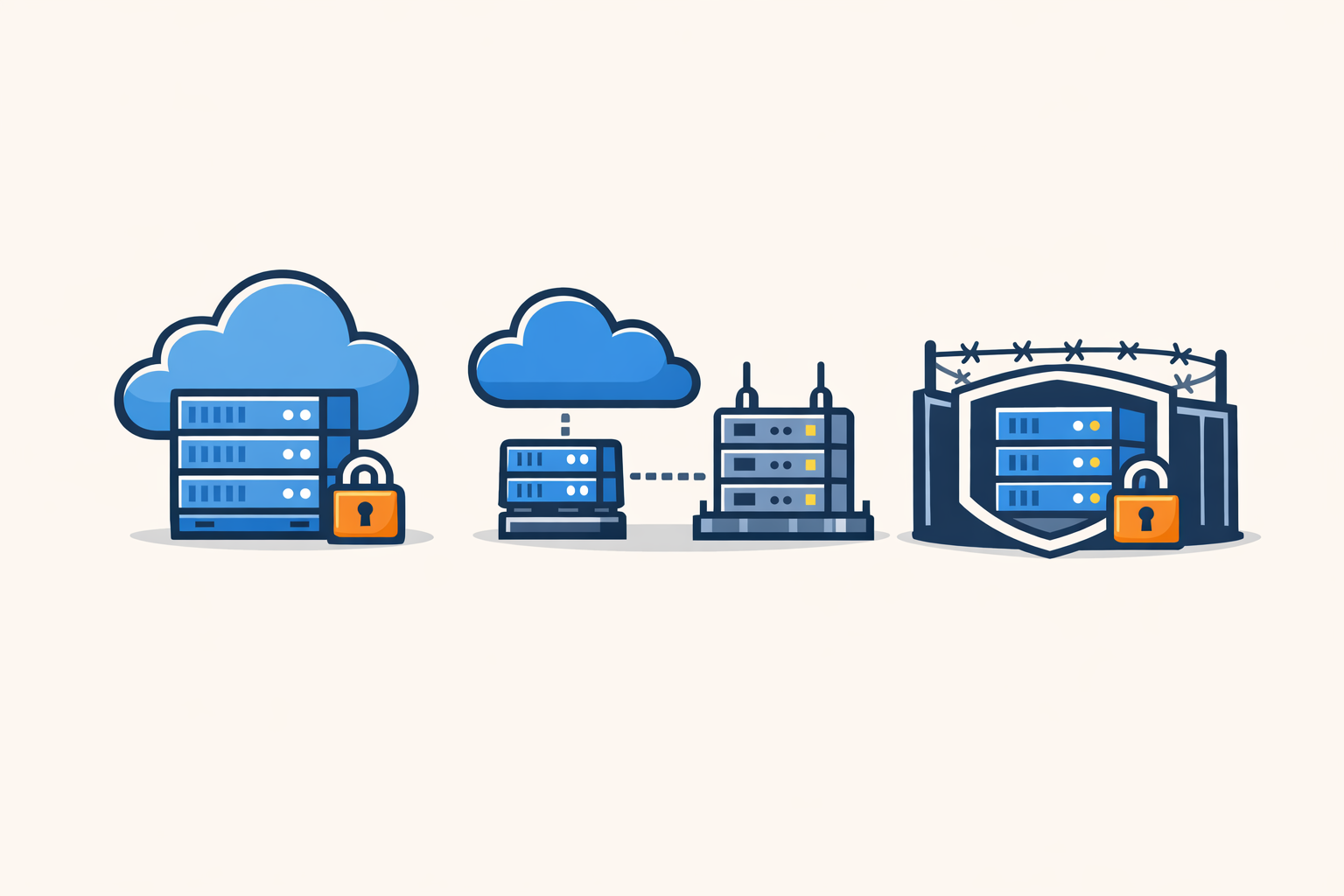
One practical way to evaluate cloud container security software is by deployment model: fully managed SaaS, hybrid deployments, and self-hosted or air-gapped deployments. Buyers who shop on feature parity alone end up with two SaaS tools that do not satisfy their FedRAMP boundary.
This guide compares cloud container security software by deployment model, pricing structure, compliance considerations, and integration fit. The structure follows the actual buyer journey: deployment model first, then pricing model, then compliance footprint, then integration fit, and finally the layered architecture that makes any of these tools useful in a real production cluster.
Key Takeaways
- The best cloud container security software in 2026 splits by deployment model first, vendor second: fully-managed SaaS, hybrid (SaaS control plane plus self-hosted sensor), and self-hosted or air-gapped. Most regulated buyers cannot use one model for every workload.
- Per the FedRAMP Marketplace authorization records, only a handful of cloud container security software vendors hold a current FedRAMP Moderate or High authorization. Buyers running federal workloads must verify status on the day of contract, not on the marketing page.
- Pricing models matter as much as feature lists. Per-vCore billing (Wiz, Sysdig) tracks workload scale, per-node billing (CrowdStrike, SentinelOne) tracks cluster footprint, per-image billing tracks build cadence, and per-developer billing (Snyk) tracks team size. Picking the wrong model on a 12-month contract can cost six figures.
- A program that buys cloud container security software without a hardened-image catalog underneath re-alerts on the same 50 to 80 inherited base-image CVEs every scan cycle. The software is the management plane. The catalog is the prevention layer.
1. What Cloud Container Security Software Means in 2026
Cloud container security software is a managed software platform that detects, prevents, or eliminates vulnerabilities, misconfigurations, and runtime threats in containerized workloads running on Kubernetes (EKS, AKS, GKE, OpenShift, Rancher), serverless container runtimes (Fargate, Cloud Run, Azure Container Apps), and self-hosted clusters.
Per Gartner's Market Guide for Cloud-Native Application Protection Platforms (Koeppen, ElTahawy, and MacDonald, August 2025), the category overlaps with Cloud-Native Application Protection Platforms (CNAPP) but is narrower. Container security software is image- and Kubernetes-centric. CNAPP adds Cloud Security Posture Management (CSPM), Cloud Infrastructure Entitlement Management (CIEM), and Data Security Posture Management (DSPM) lanes that container teams rarely buy on their own.
SaaS-Delivered vs. Self-Hosted vs. Hybrid (BYOK Control Plane)
SaaS-delivered software runs the management plane on the vendor's infrastructure. The buyer authenticates via SSO, and the tool ingests image metadata, registry feeds, and Kubernetes audit logs over the network. Onboarding takes hours.
Self-hosted software runs the management plane on infrastructure the buyer controls. Air-gapped variants ship with no outbound dependency on the vendor. Self-hosted or air-gapped deployment may be required where the system boundary prohibits vendor-managed connectivity. Other federal environments may permit appropriately certified SaaS or government-cloud services, depending on the authorization boundary and approved architecture.
Hybrid software splits the architecture: a SaaS control plane manages policy and reporting, and sensors or enforcers run inside the buyer's clusters. Bring-your-own-key (BYOK) variants let the buyer hold the encryption keys for tenant data on the vendor's control plane.
Software vs. Tools vs. Platforms: Terminology That Buyers Conflate
"Software" implies a managed product with subscription tiers, vendor support, and a published roadmap. "Tools" usually implies open-source utilities or a lightweight CLI (Trivy, Grype, Falco). "Platform" is a marketing term that some vendors apply to single-purpose software and others apply to the broader CNAPP suite. Treat the three terms as different procurement categories on every evaluation.
2. How This List of Cloud Container Security Software Was Scored
The shortlist below was scored on five practitioner criteria. Each criterion gates a different audit family or a different real-world failure mode I have watched play out on a renewal call.
- Deployment model fit. Can the software run in the buyer's required topology (SaaS, hybrid, self-hosted, air-gapped) without a six-month re-architecture?
- Subscription pricing transparency. Is the pricing model published, or does the buyer learn it on a sales call after a 30-day trial?
- Integration breadth. Does the software support AWS, Azure, and GCP plus the buyer's Kubernetes distribution and CI/CD stack?
- FedRAMP and DoD IL status. Per the FedRAMP Marketplace, is the vendor authorized at Moderate or High, or is the listing "In Process"?
- Multi-tenant data residency. Can sensitive image metadata stay in EU, UK, or US-only regions, with BYOK supported?
3. The Best Cloud Container Security Software at a Glance
The shortlist below covers the nine most-evaluated cloud container security software products in 2026. The "Federal Deployment Path" column describes the deployment topology each vendor publishes for federal workloads, not its current authorization status. Verify the live status on the FedRAMP Marketplace the day of contract.
| Vendor / Product |
Deployment Model |
Primary Pricing Lens |
Federal Deployment Path |
Differentiator |
| Wiz |
SaaS (GovCloud option) |
Per-vCore |
Isolated GovCloud tenant |
Side-scanning, no agent |
| Orca Security |
SaaS |
Per-asset |
SaaS with regional data residency |
SideScanning plus identity graph |
| Snyk Container |
SaaS |
Per-developer |
SaaS with regional data residency |
Developer-first, IDE integration |
| Fortinet Lacework FortiCNAPP |
SaaS |
Per-vCore |
Bundled with Fortinet federal stack |
Anomaly-based runtime detection |
| Sysdig Secure |
Hybrid (SaaS or self-hosted) |
Per-vCore |
Self-hosted edition for regulated workloads |
Falco-based eBPF |
| Aqua Platform |
Hybrid |
Per-node and per-image |
Self-hosted Enforcer for air-gapped clusters |
Drift prevention plus image scan |
| SentinelOne Singularity Cloud Security |
Hybrid |
Per-node |
Singularity federal tenant |
Endpoint sensor extended to Kubernetes |
| Anchore Enterprise |
Self-hosted |
Per-image |
Fully self-hosted, no outbound dependency |
Policy-as-code, air-gapped |
| Red Hat Advanced Cluster Security |
Self-hosted |
Per-node |
Inherits OpenShift's federal boundary |
StackRox upstream, OpenShift-native |
4. Best Fully-Managed SaaS Cloud Container Security Software
The best fully-managed SaaS cloud container security software in 2026 are Wiz, Orca Security, Snyk Container, and Fortinet Lacework FortiCNAPP. Each runs the management plane on the vendor's infrastructure and onboards in hours via read-only IAM roles.
Wiz
Wiz is a SaaS CNAPP that scans Kubernetes API objects, image registries, and cloud workloads using a side-scanning architecture. The platform reads block volumes attached to running pods out of band, with no DaemonSet on the node. For federal customers, Wiz publishes a separate GovCloud-deployed tenant; verify the current authorization status on the FedRAMP Marketplace before contract. Pricing is per-vCore.
Orca Security
Orca runs a similar SideScanning architecture against AWS, Azure, and GCP workloads. It maps findings to MITRE ATT&CK for Containers and surfaces lateral-movement paths through the cloud-identity graph (overly broad IAM roles, exposed service-account tokens). Pricing is per-asset, which can favor cluster topologies with many small workloads.
Snyk Container
Snyk Container is the developer-first option in the SaaS group. It integrates into the IDE, the pull request, and CI pipelines (GitHub Actions, GitLab CI, Jenkins) and prices per developer seat. The trade-off: runtime detection is shallower than the dedicated CNAPP options, so most regulated programs pair Snyk with a sensor-based product.
Fortinet Lacework FortiCNAPP
Lacework joined Fortinet in 2024 and the product now ships as Fortinet Lacework FortiCNAPP. The platform leans on anomaly-based behavioral detection across cloud and Kubernetes telemetry, which catches drift the rule-based products miss. Pricing is per-vCore. Buyers already on Fortinet's network stack get a bundled procurement path.
5. Best Hybrid Cloud Container Security Software
Hybrid cloud container security software runs a SaaS control plane plus sensors or enforcers inside the buyer's clusters. The architecture fits buyers who want SaaS reporting but cannot send pod-level telemetry to a vendor-managed cloud. The strongest options in 2026 are Sysdig Secure, Aqua Platform, and SentinelOne Singularity Cloud Security.
Sysdig Secure
Sysdig Secure ships a SaaS console and a per-node DaemonSet built on the open-source Falco eBPF probe. Detection rules map to MITRE ATT&CK for Containers. Pricing is per-vCore, and Sysdig also publishes a self-hosted edition for buyers with an air-gapped or hybrid topology.
Aqua Platform
Aqua's Enforcer agent runs as a DaemonSet that uses a kernel module on older Linux kernels and Falco-based eBPF on newer ones. Drift prevention kills any process not present in the original image, which catches the live exploitation patterns image scanners miss. Aqua's image scanner runs at build time, so build-time CVE data and runtime telemetry feed the same console. Pricing is hybrid: per-node for runtime plus per-image for build-time scanning.
SentinelOne Singularity Cloud Security
SentinelOne extends its Endpoint Detection and Response (EDR) sensor architecture into Kubernetes via eBPF. The same agent that protects EC2 hosts protects pods, with shared detection logic against the same threat model. Pricing is per-node. Buyers already on Singularity for endpoints get unified detection across endpoints, virtual machines, and containers.
6. Best Self-Hosted and Air-Gapped Cloud Container Security Software
Self-hosted and air-gapped cloud container security software runs entirely on infrastructure the buyer controls. This is the only deployment model that satisfies FedRAMP High and DoD Impact Level 5 boundary reviews where internet-connected security tooling is prohibited. The strongest options in 2026 are Anchore Enterprise, Red Hat Advanced Cluster Security, the self-hosted edition of Sysdig Secure, and hardened-image catalog software with self-hosted deployment support.
Anchore Enterprise
Anchore Enterprise focuses on policy-as-code image scanning and Software Bill of Materials (SBOM) generation. It runs entirely self-hosted with no outbound vendor dependency. Pricing is per-image. The platform integrates with most CI/CD systems and air-gapped registries, including JFrog Artifactory and Harbor.
Red Hat Advanced Cluster Security (StackRox)
Red Hat ACS is the commercial version of StackRox. It runs natively inside an OpenShift cluster (or on vanilla Kubernetes) and supports air-gapped deployments. ACS is the default Kubernetes-native security option for buyers already on Red Hat OpenShift, particularly in federal and defense workloads.
Sysdig (Self-Hosted Edition)
Sysdig publishes a self-hosted edition of the same Secure platform that runs as SaaS. The two editions share rule content, MITRE ATT&CK mapping, and the Falco engine. Buyers can start on SaaS and migrate to self-hosted later when a regulated workload requires it, without rebuilding their detection content.
Hardened-Image Catalog Software With Self-Hosted Deployment
Hardened-image catalogs are not detection software; they are prevention software. They publish minimal container images built directly from upstream source on a continuous rebuild cadence, with Cosign signatures and CycloneDX SBOMs per digest. Self-hosted catalogs mirror to the buyer's registry, which removes the outbound dependency on a vendor-hosted gallery. See our hardened container images foundation explainer for the prevention-layer mechanics.
7. Pricing-Model Comparison: Per-vCore, Per-Node, Per-Image, Per-Developer
Cloud container security software prices on one of four primary lenses. Each lens scales with a different operational signal, so the wrong lens on a 12-month contract is the most expensive line item I have seen on a renewal.
| Pricing Model |
Scales With |
Best Fit |
Hidden Cost |
| Per-vCore |
CPU footprint of running workloads |
Steady-state production clusters |
Autoscaling spikes during incidents |
| Per-node |
Number of Kubernetes nodes |
Predictable cluster sizes |
Dense pod-per-node deployments under-charged |
| Per-image |
Distinct images scanned per month |
Heavy CI/CD with high build cadence |
Polyrepo monoliths producing 1,000 images per day |
| Per-developer |
Engineering headcount |
Developer-first scanners (Snyk) |
Contractors and vendor seats counted twice |
Hidden cost watchlist: image substitution effort during onboarding, runtime sensor egress fees from the cloud provider, and audit-evidence add-ons billed separately from the base subscription.
8. Integration Matrix for Cloud Container Security Software
The integrations that matter on a 30-day pilot fall into three buckets: CI/CD, cloud platform, and Kubernetes distribution. Governance, Risk, and Compliance (GRC) integrations matter on the renewal, not on the pilot.
| Category |
Common Integrations |
Why It Matters |
| CI/CD |
GitHub Actions, GitLab CI, Argo, Jenkins, CircleCI |
Build-time CVE data feeds the runtime console |
| Cloud Platforms |
AWS, Azure, GCP native services |
IAM scope, audit-log ingestion, registry reads |
| Kubernetes Distros |
EKS, AKS, GKE, OpenShift, Rancher, vanilla |
Sensor compatibility and admission policy |
| Compliance / GRC |
ServiceNow GRC, Hyperproof, Drata, Vanta |
Audit-evidence export saves manual collection |
For Slack and webhook routing into existing on-call workflows, see our post on workflow automation providers for Minimus images.
9. Compliance and Data-Residency Considerations
Compliance footprint is the gating question for federal, defense, and regulated financial workloads. Per the FedRAMP Marketplace, authorization status changes month to month, so the audit-evidence package on a vendor's marketing page is not a substitute for the live status.
- FedRAMP Moderate. Required for non-classified federal workloads. Some CNAPP and cloud-security vendors offer government editions with current FedRAMP certification, but the exact product edition, certification class, included capabilities, and deployment scope must be verified in the FedRAMP Marketplace.
- FedRAMP High. Required for sensitive but unclassified federal workloads. The list of authorized vendors is short, and many SaaS-only products are not on it.
- DoD Impact Level 4 and 5. Required for DoD workloads. IL5 deployments require an approved architecture and cloud-service offering appropriate to the workload and authorization boundary; this does not automatically mean the product must be self-hosted.
- GDPR data residency. EU regions and BYOK control of customer-managed keys. Several US-headquartered SaaS vendors offer EU regions on request.
- SOC 2 Type II. Industry baseline. Treat this as table stakes, not a differentiator.
For a deeper walkthrough of how hardened images map to the relevant control families, see our FedRAMP compliance with Minimus images guide.
10. Common Pitfalls When Buying Cloud Container Security Software
Three pitfalls account for most of the failed evaluations I have seen on a renewal call.
Buying SaaS-Only Software for Air-Gapped Workloads
A SaaS-only management plane cannot operate in an air-gapped FedRAMP High or IL5 environment. The vendor will sometimes pitch a "GovCloud" deployment as the answer, but the GovCloud plane is still managed by the vendor, not the buyer. Verify the deployment topology against the audit boundary on day one of evaluation, not week eight.
Per-Image Pricing Meeting CI/CD Scale
Per-image pricing looks cheap on a small registry. On a CI/CD pipeline that produces 1,000 images per day from a polyrepo monolith, the line item compounds fast. Model the pricing against actual build cadence, not registry size.
"Multi-Cloud" Claims That Omit GCP or Air-Gapped
Several SaaS vendors describe themselves as multi-cloud while offering only AWS and Azure coverage at general availability. GCP support is often "in beta" for the first 18 months, and air-gapped is rarely included. Read the fine print before signing.
11. The 2026 Reference Stack: How the Software Composes with Hardened Images
Cloud container security software is the management plane. A hardened-image catalog is the prevention layer. A per-node sensor is the runtime layer. The 2026 reference architecture combines all three.
| Layer |
Role |
Architecture |
| Catalog |
Eliminates inherited base-image CVEs at build time, ships SBOM and signed provenance |
Registry-side hardened images |
| Software |
Scans images, parses SBOM, manages policy and reporting |
SaaS, hybrid, or self-hosted |
| Sensor |
Detects runtime exploits, drift, and escape attempts |
Per-node eBPF or kernel agent |
A program that ships only the software layer re-alerts on the same 50 to 80 inherited base-image CVEs every scan cycle. A program that adds a hardened-image catalog underneath cuts Cloud Workload Protection Platform (CWPP) alert volume by roughly 90% because the catalog removed the inherited input. This is the layered pattern aligned with NIST SP 800-190, which recommends controls for reducing image risk, including using trusted images, minimizing unnecessary components, maintaining images, and validating image integrity. SBOMs and signed provenance can support this work, but the publication should not be described as directly requiring a modern SBOM inventory.
How Minimus Complements Your Cloud Container Security Software
Minimus publishes hardened, minimal container images built directly from upstream distributions on a continuous rebuild cadence. Each image ships with a Cosign signature, a CycloneDX SBOM, VEX-aligned vulnerability-exploitability information, and a 48-hour critical CVE remediation SLA. Per Minimus platform data, replacing a standard public image with the Minimus equivalent reduces CVE counts by over 95% on the first build, in our internal scans.
Image Creator lets teams build private custom images on the same minimal base when the public catalog does not cover a specific runtime configuration, with Minimus maintaining those private images under the same SLA. Minimus images sit underneath whichever cloud container security software you buy (Wiz, Sysdig, Aqua, Anchore) and reduce the inherited vulnerability surface those tools would otherwise re-alert on every scan cycle. See our Minimus and Wiz partnership post for one reference integration, and the Minimus platform overview for how the catalog ships into your existing software.
Browse the catalog at images.minimus.io or read the verification, SBOM, and admission-policy guides at docs.minimus.io.
FAQ on Cloud Container Security Software
What Is the Best Cloud Container Security Software for FedRAMP Workloads?
The best cloud container security software for FedRAMP workloads is the option whose deployment model fits the audit boundary and whose authorization status on the FedRAMP Marketplace is current on the day of contract. For FedRAMP Moderate, evaluate SaaS-based products with a published federal deployment path, such as Wiz GovCloud, Orca Security, and Sysdig Secure. For FedRAMP High and DoD Impact Level 5, the field narrows to self-hosted or air-gapped products such as Anchore Enterprise and Red Hat Advanced Cluster Security.
Is SaaS-Delivered Cloud Container Security Software Safe for Sensitive Data?
Whether SaaS-delivered security software is appropriate depends on the sensitivity of the data collected, tenant isolation, access controls, encryption, regional processing, retention, subprocessors, incident-response terms, and the organization’s compliance boundary. SOC 2 Type II is useful evidence, but it does not by itself establish that a product is safe or suitable.
It is not safe for FedRAMP High or DoD IL5 workloads where the audit boundary forbids vendor-managed control planes. For those workloads, a government-cloud, hybrid, self-hosted, or air-gapped deployment may be required, depending on the approved system architecture.
What Is the Difference Between Cloud Container Security Software and a CNAPP?
Cloud container security software is image- and Kubernetes-centric. A CNAPP adds CSPM, CIEM, and DSPM lanes that go beyond containers into the broader cloud account. Per Gartner's 2025 Market Guide for Cloud-Native Application Protection Platforms, the two categories overlap but are not interchangeable. Many container teams buy the container software first and add CNAPP coverage later.
Can I Run Cloud Container Security Software in an Air-Gapped Environment?
Yes, but only the self-hosted variants. Several vendors offer self-hosted or disconnected deployment options, including products from Anchore, Red Hat, and Sysdig. Buyers should verify the exact edition, licensing service, update process, telemetry behavior, signature or vulnerability-feed synchronization, and any remaining outbound dependencies before treating a deployment as fully air-gapped.
Hardened-image catalog software with self-hosted deployment support also works in air-gapped registries (JFrog Artifactory, Harbor, GitLab Container Registry).
How Do Per-vCore, Per-Node, and Per-Image Pricing Compare?
Per-vCore pricing scales with the CPU footprint of running workloads and tends to spike during autoscaling incidents. Per-node pricing scales with the number of Kubernetes nodes, which favors dense pod-per-node deployments. Per-image pricing scales with the number of distinct images scanned per month, which can compound fast on CI/CD pipelines that produce many builds. Map the pricing model to the operational signal you actually run before the renewal, not after.











.svg)
.svg)



.svg)

.svg)