The recent announcements of frontier AI models built explicitly for cybersecurity, like Claude Mythos and OpenAI’s GPT-5.4-Cyber, have sent shockwaves through the industry. These models are now proving they can autonomously discover thousands of zero-day vulnerabilities across major operating systems without human intervention.
While researchers debate the immediate threat level (although the fact it was already tapped into by third parties pretty much determines that debate), the long-term reality is undeniable: AI is rapidly lowering the barrier to entry for vulnerability exploitation. This acceleration is putting enormous pressure on developers and security teams.
The Defender’s Dilemma: We Can't Patch Everything
Organizations are already drowning in CVEs. Statistically, most companies only manage to patch about 10% of the open vulnerabilities in their environment.
The traditional security playbook revolves around trying to perfectly prioritize that 10%, filtering by severity, active exploits, and reachability. But when AI drastically shrinks the window between vulnerability disclosure and active exploitation, prioritizing a never-ending backlog is a losing battle.
If you can’t out-patch the attackers, what's the alternative?
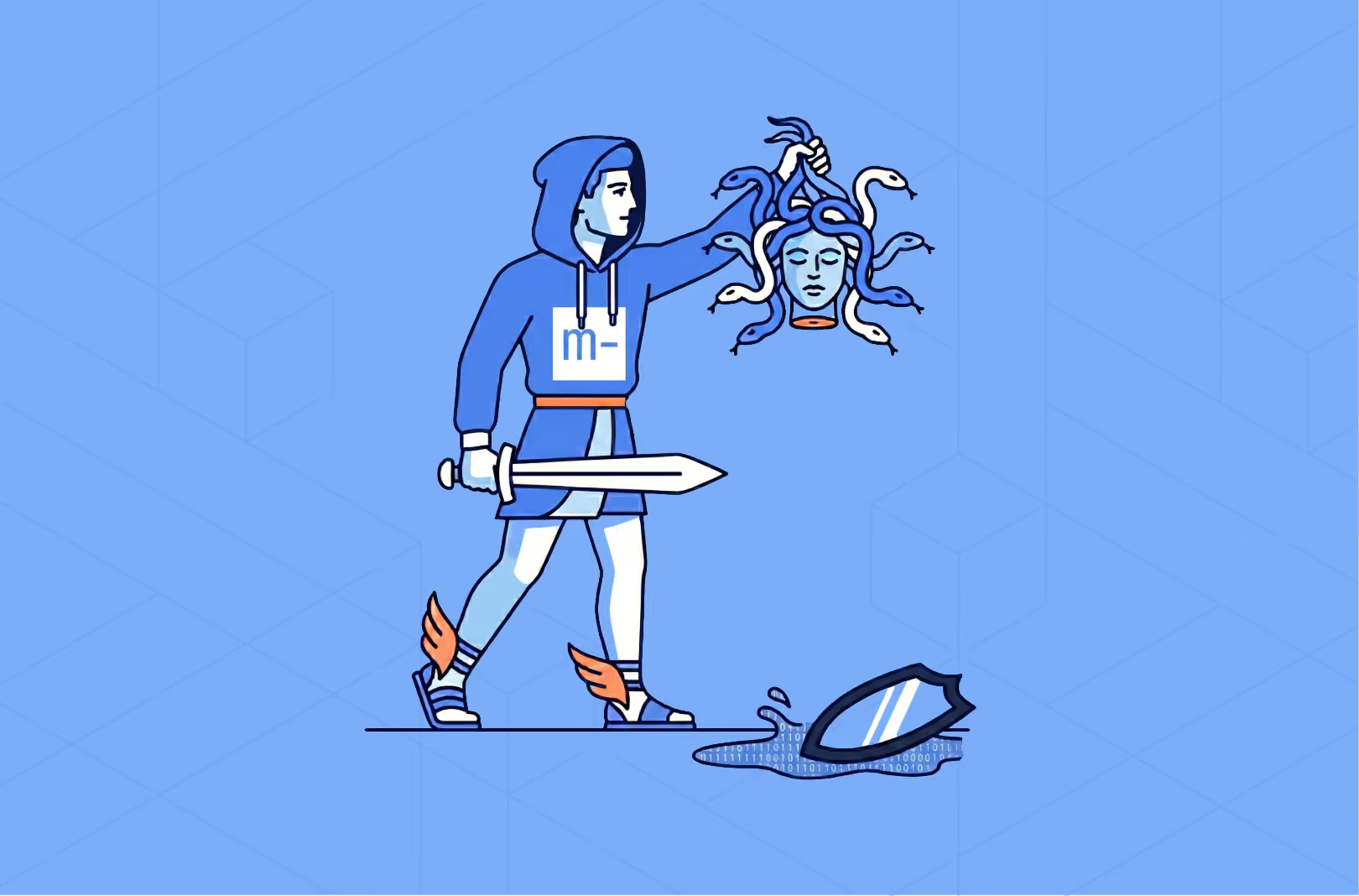
The Minimus Approach: Building Security In, Not Cutting Risk Out.
The most effective vulnerability is the one that doesn't exist on your system in the first place. Instead of trying to filter through the noise, you need to drastically reduce the amount of code hitting your environments.
This is where Minimus changes the game.
Consider the standard way developers build a Python application. By pulling the latest public container from Docker Hub, they instantly inherit an image containing 472 OS packages—bringing along 314 known CVEs (including 9 Criticals)—before writing a single line of their own code. Hundreds of these utilities are entirely unnecessary for running the application.
By contrast, the Minimus Python image contains just 23 OS packages. It gives you exactly what is required to accomplish the mission, reducing your baseline risk from 314 known CVEs down to a manageable 2.
Breaking the Attack Chain
This radical reduction doesn't just eliminate CVEs; it directly neutralizes post-breach attacks. By stripping out unnecessary shells, cURL, wget, and other utilities that applications don't actually need, Minimus prevents attackers from "living off the land." Without these tools, their ability to gain persistence, perform reconnaissance, and exfiltrate data is fundamentally broken.
Shift from Reactive Patching to Proactive Risk Reduction
As AI makes finding vulnerabilities faster and easier for adversaries, reactive patching is no longer sufficient.
Minimus delivers hardened, minimal base images that fix the problem at the source. Instead of chasing down thousands of AI-generated security findings, you can eliminate them before they are ever deployed, all without changing how your team builds or ships software.
Ready to drop your CVE count to zero? Get a demo of Minimus today.












.svg)
.svg)




.svg)




.svg)