Minimus is ending operations. We appreciate the support of our many customers globally and are proud to have served you. Unfortunately, the current business and investment climate has resulted in a situation in which we are unable to continue operations. We acknowledge the effort that transitioning from our images will require and we are committed to providing customers with a stable transition period.
Beginning on Monday 24 August 2026, we will begin a 60 day maintenance period for the product and images. During this period, we will make necessary bug fixes to the overall product, provide commercial support, and continue to maintain images with upstream updates. On Thursday 22 October 2026, we will cease operations and turn off the Minimus registry (reg.mini.dev). Images pulled from the registry prior to 22 October will, of course, continue to function, but no further updated images will be provided.
For Enterprise Edition customers, we are committed to ensuring a fair and orderly conclusion to our commercial relationships. We will reach out to each Enterprise Edition customer individually, beginning on 24 August, to discuss the structured termination of your agreement, including any applicable refunds for the remaining contract period beyond 22 October.
While this is not the outcome that any of us wanted, we hope that this approach provides customers with ample opportunity to smoothly transition.
Understanding CISA BOD 26-04: Prioritizing Security Updates Based on Risk
By
Neil Carpenter
June 11, 2026
On June 10th, 2026, CISA published BOD (Binding Operational Directive) 26-04, updating guidance for Federal civilian agencies on remediating software vulnerabilities. I believe this document represents a significant change in how CISA mandates (for affected agencies) and recommends (for everybody else) prioritizing which CVEs to address and how quickly to address them. As somebody who spends more time than is healthy immersed in vulnerability management and CVE metadata, here are my initial thoughts on what it means.
What is a BOD and Who is Affected?
Quoting from the directive itself, “A Binding Operational Directive is a compulsory direction to federal, executive branch, departments, and agencies for purposes of safeguarding federal information and information systems.” In other words, a BOD defines required (“compulsory”) actions for covered federal agencies.
The BOD covers federal executive branch agencies with exclusions for “national security systems” and some systems operated by the Department of War and the intelligence community. While the directive does not, generally, apply to contractors, it does explicitly apply to FedRAMP certified offerings.
Two trends are colliding to create increasing friction for vulnerability management teams trying to address the risk of CVEs in their organizations’ assets. These trends, the inexorable increase in discovered vulnerabilities in the ecosystem and the reduced time to exploit the ~1% of CVEs that are publicly exploited, have been most recently discussed in the context of AI-powered vulnerability research by tools like Claude Mythos, but both phenomena have been happening in our industry for decades now.
The increase in the number of CVEs has also increased the frequency and number of updates that organizations need to apply. All things being equal, this naturally results in more vulnerabilities going unpatched longer, as organizations can only apply so many fixes. Meanwhile, reduced time-to-exploit makes it critical that CVEs that are known to be exploited (or that might be disastrously exploited) are addressed faster.
What Changed in CISA BOD 26-04?
Earlier, I described BOD 26-04 as “a significant change” and, if anything, I might’ve been understating the case. There are three changes that I think are particularly impactful.
Internet-Exposed Assets Receive Higher Priority
The directive prioritizes systems that are exposed to the internet. This is an acknowledgement that, while threat actors might exploit vulnerabilities as part of post-compromise lateral movement, it’s far less likely. The vast majority of exploitation happens on public-facing systems.
New Vulnerability Remediation Timelines
BOD 26-04 introduces an extremely expedited 3-day timeframe for the most critical vulnerabilities. Other tiers are 14-day, 60-day, and “next system upgrade”. I should also note that these are calendar days rather than business days; people who publish serious CVE bulletins on Fridays are going to be widely reviled, I suspect.
Large organizations are going to have to work very hard to meet 3-day timelines, particularly if they have a Change Advisory Board.
Prioritization
I believe this to be the largest change. Today, teams usually start with the CVSS score, which measures the potential severity of a CVE, and layer additional prioritization on top of that. Remediation timelines have been tied to the CVSS score; for example, a critical CVE might have a 14 day goal.
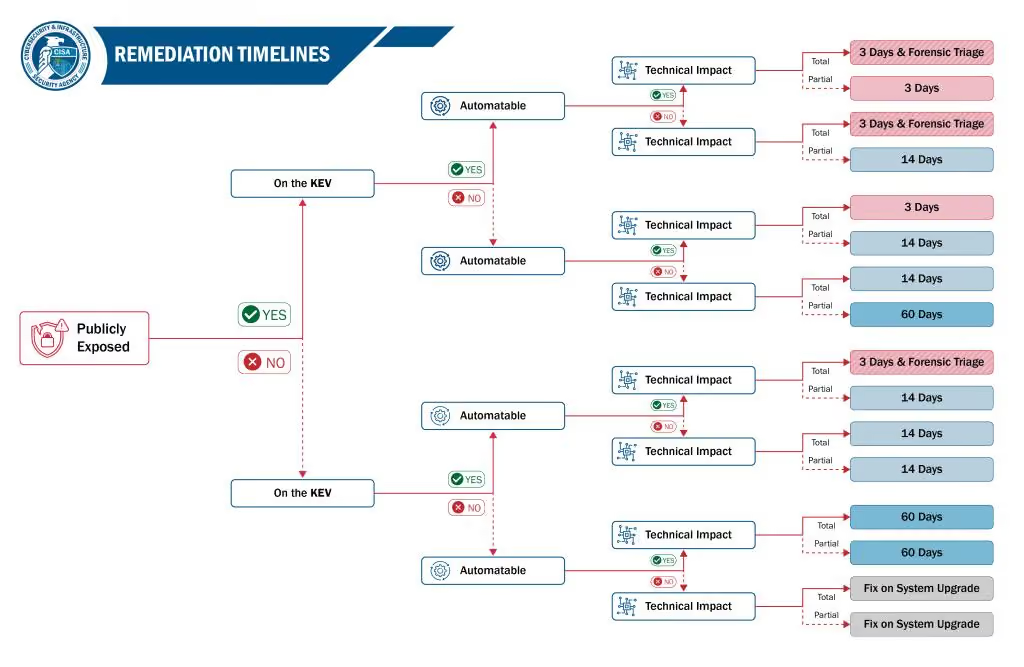
DOB 26-04 is a drastically different approach. CVSS score doesn’t factor into prioritization at all. Instead, the prioritization is built on an SSVC (Stakeholder-Specific Vulnerability Categorization) style decision tree. The decision tree in the directive is slightly different from the earlier version, focusing on four criteria:
Exposure: Is the asset exposed to the Internet?
CISA KEV: Is the CVE on the list of Known Exploited Vulnerabilities?
Automatable: Can a threat actor fully automate exploitation of the vulnerability?
Technical Impact: Does exploitation result in partial or total control?
As seen in the diagram, the answers to these four questions tells us how quickly the asset must be patched for the CVE. Additionally, for the most dire paths, there is a requirement for a forensic assessment to make sure the asset hasn’t already been compromised.
Remediation Timeline tree from CISA BOD 26-04
Gaps in CISA BOD 26-04
There are a few unresolved issues that I think organizations will need to be concerned about as they plan to comply with this directive.
CVE Metadata from SSVC
The decision tree in the directive relies on two specific pieces of metadata from SSVC that haven’t been part of the data that NVD provides for vulnerabilities:
whether exploitation can be automated by an attacker
whether exploitation results in partial or complete compromise
As part of the Vulnrichment program, CISA has been making this metadata available separately for CVEs that CISA is enriching. Thankfully, NIST has committed to adding SSVC metadata to NVD starting on June 17th, 2026.
Additionally, SSVC metadata has not, traditionally, covered all CVEs. Hopefully, the CVE Numbering Authorities who submit CVE reports will also begin to provide SSVC enrichment.
Tooling for SSVC-Based Prioritization
The much larger gap is tooling. There are few, if any, commercially available vulnerability scanners, CNAPPs, AppSec platforms, and associated tools that support the SSVC metadata or SSVC-style decision trees for prioritization. Organizations will have to work with existing vendors or implement new approaches to operationalize this new approach to prioritization and do so within the timelines that the directive establishes.
Conclusion
I’ve been advocating for SSVC implementations for years as a way of solving the problems with traditional CVE prioritization. I believe, at least in theory, that this is an evidence-based approach that lets defenders make better use of limited resources to address the flood of vulnerabilities that they’re wrestling with.
It’s also encouraging to see CISA commit to regular, data-driven reviews of the directive’s outcomes with updates to course-correct as results are available. BOD 26-04 represents a shift towards prioritizing vulnerabilities based on real-world risk rather than theoretical severity, though its success will depend on the quality of the underlying vulnerability metadata and how well organizations and vendors can operationalize it.













.svg)
.svg)




.svg)




.svg)