Last week CISA issued Binding Operational Directive 26-04, and if you run security or platform engineering anywhere, federal agency or not, you should read it as a forcing function for how the next decade of vulnerability management is going to work.
The headline number is the one that stops people cold: three days. For the most dangerous class of vulnerabilities, federal civilian agencies now have seventy-two hours to remediate and to run a forensic triage to determine whether they've already been breached. Not fifteen days. Not thirty. Three.
I want to walk through what the directive actually says, why it landed now, and why I think most organizations are about to discover that their entire remediation strategy was built for a world that no longer exists.
What BOD 26-04 Actually Requires
The old model treated vulnerabilities as a queue to be worked down by severity score. CISA just replaced that with a risk-based rubric. Under BOD 26-04, agencies prioritize based on four questions:
- Is the affected asset publicly exposed?
- Can the exploit be fully automated with every step and no human in the loop?
- Does exploitation hand the attacker meaningful access up to full system takeover?
- Is it being actively exploited in the wild (e.g., listed in CISA's Known Exploited Vulnerabilities catalog)?
When all four are true, the clock is three days for remediation plus forensic triage. Vulnerabilities that trip fewer criteria get proportionally more time, which is the genuinely smart part of this directive: it tells defenders where to spend their attention instead of drowning them in an undifferentiated CVE backlog. Agencies get 60 days to update their internal processes and 180 days to fully meet the new timelines.
This supersedes the patching directives from 2019 and 2021, where the most urgent bugs got 15 days and the next tier got 30. In other words, CISA just compressed its most aggressive deadline by 80%.
Why Now: The AI Vulnerability Storm
CISA didn't pick three days arbitrarily, and acting cybersecurity lead Chris Butera said the quiet part out loud: "Defenders cannot afford to take weeks to patch systems that can be autonomously exploited en masse."
That sentence is the whole story. The reason this directive exists is that the window between a vulnerability being discovered and being weaponized has collapsed. AI is now assisting both researchers and adversaries in finding flaws, and it's doing it at a pace and volume that the human-disclosure-era playbook was never designed to absorb.
Recent advances in AI-driven vulnerability research have accelerated this discussion. Tools capable of identifying and helping exploit software flaws at unprecedented speed have made it clear that traditional remediation timelines may no longer be sufficient. CISA's directive is a recognition of that reality.
When an attacker can chain discovery, exploit generation, and mass deployment with no human bottleneck, a 30-day SLA isn't a remediation policy. It's a 30-day open door.
The Uncomfortable Truth: 3 Days is Impossible the Old Way
Here's where I want to be direct, because I think a lot of teams are going to nod along with this directive and then quietly assume their existing process can absorb it. For many organizations, it can't.
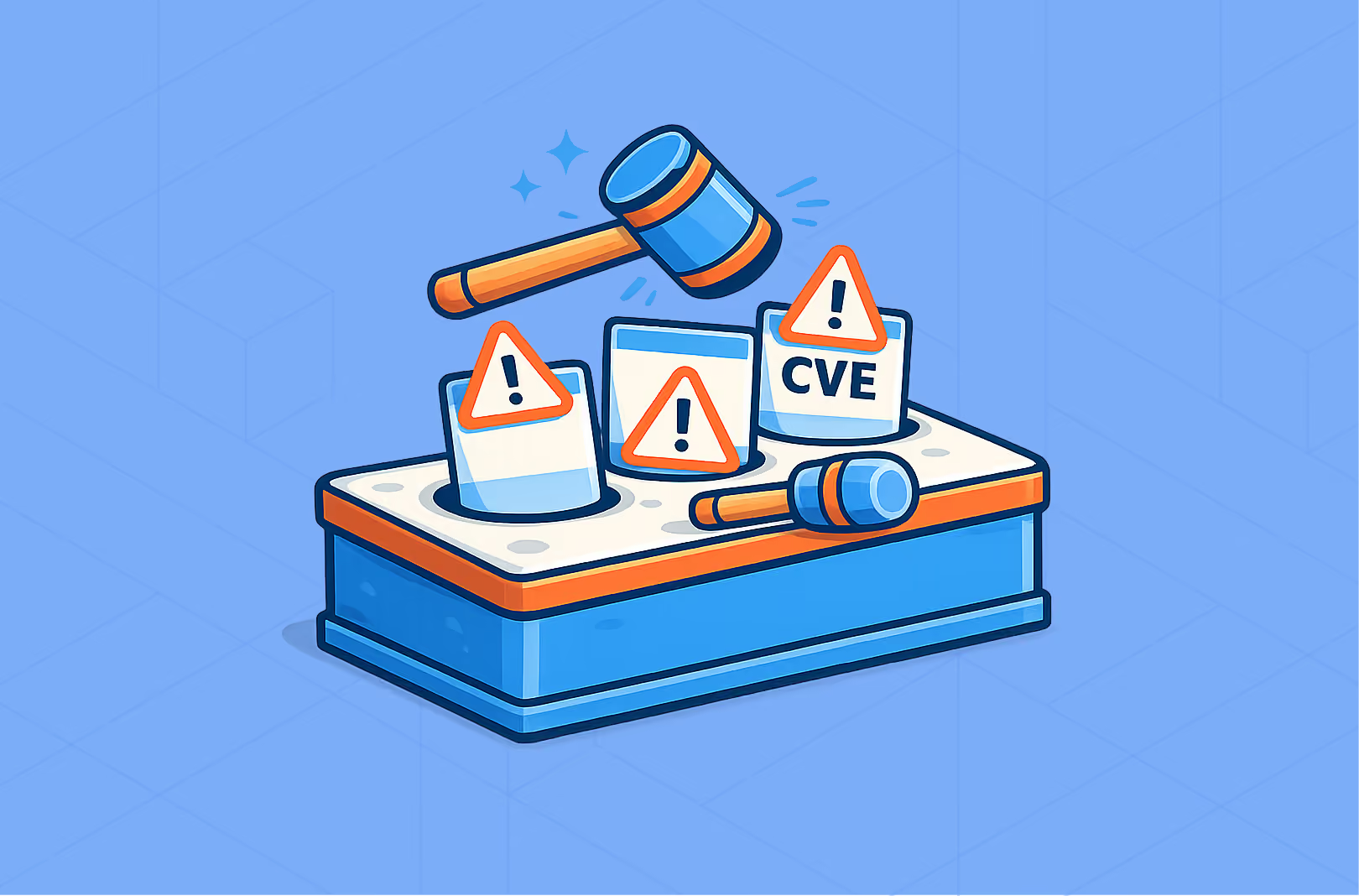
If your security program is built on detecting vulnerabilities and then chasing each one, scan, ticket, triage, find the owner, test the patch, schedule the deploy, you are playing whack-a-mole. And the mallet just got 5x heavier while the moles started multiplying on their own. You cannot scan-and-chase your way to a 72-hour SLA across a fleet of thousands of images and dependencies. The math doesn't work, and adding more analysts doesn't fix math.
The teams that hit these timelines won't be the ones who patch faster. They'll be the ones who have less to patch in the first place and who can update what remains in one motion instead of a thousand.
The Shift: Rebase to a Hardened Baseline, Don't Chase CVEs
This is the architectural change I think BOD 26-04 should push every organization toward, and it's the thesis Minimus was built on.
Stop treating your production base images as a fixed substrate that you bolt patches onto. Start treating the hardened, minimal baseline as something you continuously rebase onto.
Shrink the Attack Surface
Most of the CVEs in a typical container image come from software the application never even uses, including shells, package managers, and libraries dragged in by a bloated base. Build images from source with only what the application needs to run and you eliminate whole categories of vulnerabilities before a scanner ever sees them.
In practice, this is often the difference between an image with hundreds of vulnerabilities and one with a small fraction of that number.
Make Updating a Rebase, Not a Manhunt
When your baseline is continuously rebuilt from upstream source with the latest fixes, responding to a critical vulnerability stops being a per-CVE investigation and becomes a single operation: pull the new hardened image, redeploy, done.
That is a workflow that can realistically operate within a three-day remediation window and, in many cases, within hours.
When the floor you stand on is already minimal and already current, "patch the critical vulnerability in three days" stops being a fire drill. It becomes a Tuesday.
The Bottom Line
BOD 26-04 is technically a federal mandate, but read it as a preview. Risk-based prioritization and shorter remediation timelines are coming to your compliance frameworks, customer security reviews, and incident response discussions whether you're a government agency or not, because the threat landscape that motivated them isn't limited to federal systems.
You can respond by running faster on the same treadmill. Or you can change the surface you're running on.
Organizations that succeed in this environment will combine better prioritization with simpler, easier-to-maintain software stacks. The fewer unnecessary components you have to secure, the easier it becomes to meet increasingly aggressive remediation timelines.
Three days is only terrifying if you're still playing whack-a-mole. Put the mallet down.
How Minimus Can Help
Minimus helps organizations reduce vulnerability volume at the source by providing hardened, minimal container images built from upstream source code and continuously maintained with the latest security fixes. Instead of spending cycles chasing thousands of individual CVEs, teams can start from a dramatically smaller attack surface and update through simple image rebases.
If you're facing increasingly aggressive remediation timelines, explore Minimus to see how our minimal images simplify your vulnerability management.













.svg)
.svg)




.svg)




.svg)