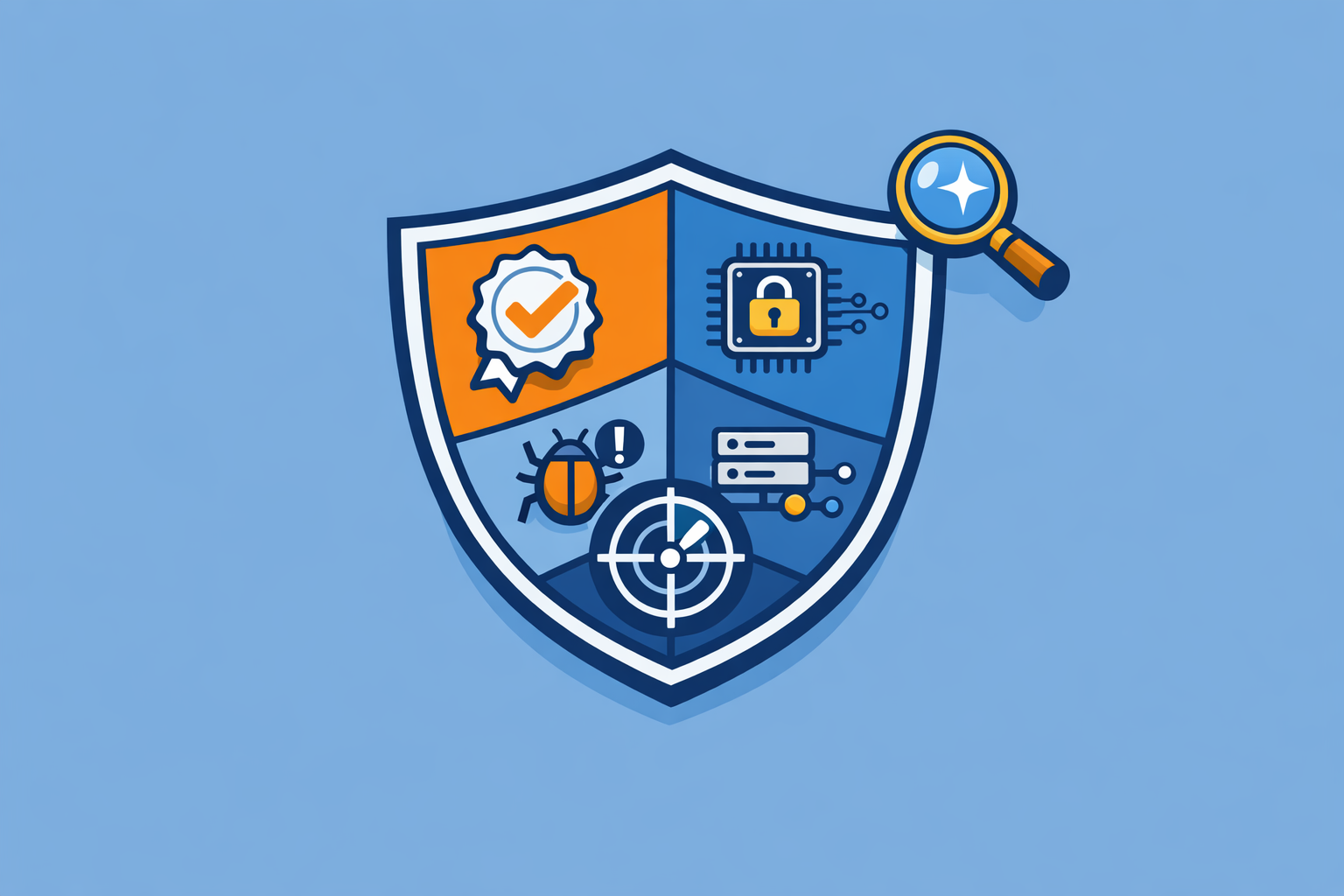
No vendor can credibly call itself the most secure cloud container security tool without producing five categories of independently verifiable evidence: third-party certifications, cryptographic and supply-chain integrity, vulnerability handling, deployment-security model, and runtime detection accuracy. Every other "most secure" claim is marketing.
This guide explains the architecture, risk domains, compliance considerations, and rollout steps involved in building an enterprise container security program.
Key Takeaways
- The most secure cloud container security tool is the one whose vendor produces verifiable evidence across five categories: third-party certifications, cryptographic integrity, vulnerability-handling SLAs, deployment model, and detection accuracy. CISA's SBOM Minimum Elements and NIST SP 800-190 §4.1.1 anchor the evidence requirements.
- The artifacts to demand from any vendor claiming "most secure" are a FedRAMP authorization listing on marketplace.fedramp.gov (not "in process" or "ready"), a FIPS 140-3 entry on the NIST Cryptographic Module Validation Program list, a cryptographically signed SBOM in CycloneDX or SPDX format, a published Vulnerability Disclosure Policy with a 48-hour PSIRT SLA, and SLSA Level 3 build provenance.
- No single tool earns the "most secure" label alone. The defensible 2026 answer is a layered defense: a hardened-image catalog at build, signed attestations across the registry, eBPF-based runtime sensors with a FIPS 140-3 validated cryptographic module, and a compliance evidence pack that maps each artifact to a specific control number.
- The fastest disqualifiers for any secure container software claim are "zero CVE" without a published SBOM and VEX, "FedRAMP ready" branding (a marketing label, not an authorization status), and "AI-powered detection" with no MITRE Engenuity ATT&CK Evaluation result to back it.
Why "Most Secure" Is a Meaningless Claim Without Evidence
"Most secure" is a superlative claim, and superlative claims about software need evidence the buyer can verify independently. The US Federal Trade Commission's endorsement guidelines and Google's Search Quality Rater Guidelines both treat unsubstantiated superlatives as a trust signal against the source. For container security vendors, the operational test is clean: can the vendor produce evidence across five categories, dated, signed, and tied to a named framework control?
Vendor Marketing vs. Verifiable Security Posture
Vendor pages call themselves the "most secure," the "only zero-trust," or "the secure container tool of choice" as front-page banners with no linked artifact. A verifiable posture replaces each banner with a specific document: a FedRAMP package excerpt, a NIST CMVP certificate number, a public PSIRT advisory feed, a Sigstore signature digest. If the artifact does not exist, the claim does not exist.
The Five Evidence Categories That Justify the Superlative
The five categories are third-party certifications, cryptographic and supply-chain integrity, vulnerability handling, deployment-security model, and runtime detection accuracy. A defensible 2026 evaluation scores a vendor across all five with a weighted matrix, not a feature checklist.
Evidence Category 1: Third-Party Security Certifications
Third-party security certifications are audit artifacts a vendor cannot self-issue. The strongest 2026 certifications for a container security tool are FedRAMP Moderate or High authorization, DoD Impact Level 4 or 5, SOC 2 Type II, and ISO 27001 with the 27017 and 27018 extensions for cloud workloads and PII processing.
FedRAMP Authorization Status: Authorized vs. Ready vs. In Process
FedRAMP has three statuses on the FedRAMP Marketplace: "FedRAMP Authorized," "FedRAMP In Process," and "FedRAMP Ready." Only "Authorized" means an agency has issued an Authority to Operate. "Ready" is a 3PAO readiness assessment, not an authorization. Vendor pages that say "FedRAMP-compliant" without a Marketplace listing fail this test.
SOC 2 Type II, ISO 27001, and DoD Impact Levels
A SOC 2 Type II report covers 6–12 months of operating effectiveness, not just control design. ISO 27001 certifies an information-security management system. DoD Impact Level 4 covers Controlled Unclassified Information; Impact Level 5 covers National Security Systems. Request the report period, the auditor's name, and the certificate number for each.
Evidence Category 2: Cryptographic and Supply-Chain Integrity
Cryptographic and supply-chain integrity is the technical evidence that an image is what the vendor claims and came from the pipeline the vendor claims. The four artifacts are a FIPS 140-3 validated cryptographic module, a cryptographically signed SBOM in CycloneDX or SPDX format, published VEX statements, and SLSA Level 3 build provenance attestations.
FIPS 140-3 Validated Cryptographic Modules
FIPS 140-3 is the US federal standard for cryptographic modules, administered by NIST through the Cryptographic Module Validation Program. A validated module has a CMVP certificate number and a validation date. "FIPS-aligned" or "FIPS-compatible" with no certificate number is not validation. For practical guidance on getting images through the CMVP path, the FIPS 140-3 validation for container images walkthrough breaks down the three accepted approaches.
Signed SBOMs, Published VEX, and SLSA Level 3 Attestations
A Software Bill of Materials (SBOM) is a machine-readable inventory of every package and version in an image. CISA's SBOM minimum elements define seven required fields. A Vulnerability Exploitability eXchange (VEX) statement declares whether a CVE in an SBOM is actually exploitable in that build. SLSA Level 3 attestations prove the build ran in a hardened, tamper-resistant environment. Without all three, signed, an "evidence pack" is a screenshot.
Evidence Category 3: Vulnerability Handling
Vulnerability handling is how a vendor responds when a CVE lands in its own product. The verifiable artifacts are a public Vulnerability Disclosure Policy (VDP), a named Product Security Incident Response Team (PSIRT) contact, a published Mean Time to CVE (MTTC) target, and a bug bounty program with documented severity payouts.
Published VDP, PSIRT SLA, and Bug Bounty Scope
A credible 2026 PSIRT response time for a critical CVE in the vendor's own product is 48 hours from upstream disclosure to advisory publication. Bug bounty programs hosted on HackerOne or Bugcrowd publish severity payout tables; "responsible disclosure" pages without a payout table are not a bounty program. For prioritization logic once a CVE lands, the vulnerability intelligence walkthrough explains how KEV, EPSS, and VEX combine to filter the queue.
CISA KEV Track Record
The CISA Known Exploited Vulnerabilities catalog lists CVEs under active exploitation. A "most secure" vendor either has zero of its own products listed or has a documented post-mortem and patch SLA for any that have been. CVE-2024-3094 (xz-utils backdoor, CVSSv3 10.0) and CVE-2024-21626 (runC "Leaky Vessels" escape, CVSSv3 8.6) are recent reference points for how fast a vendor must move.
Evidence Category 4: Deployment-Security Model
Deployment-security model evidence covers where and how a buyer can run the tool without surrendering control of keys, data, or network paths. The four artifacts are air-gapped and self-hosted deployment support, data-residency controls, customer-managed encryption keys, and documented control-plane tenancy.
Air-Gapped Self-Hosted Deployment
Air-gapped deployment is mandatory for classified federal workloads and most DoD Impact Level 5 boundaries. A vendor that requires an outbound TLS connection to its SaaS control plane for license validation, signature checks, or telemetry cannot run air-gapped. Mirroring to JFrog Artifactory, Google Artifact Registry, or DoD Iron Bank is the standard pattern, documented in our FedRAMP compliance with Minimus guide.
Customer-Managed Keys and Single-Tenant Control Plane
Customer-Managed Keys (CMK) backed by AWS KMS, Azure Key Vault HSM, or Google Cloud HSM mean the customer holds key custody and can rotate or revoke at will. A single-tenant control plane runs in dedicated infrastructure, not a shared SaaS multi-tenant pool. Request the key-rotation cadence, the HSM model, and the multi-tenant isolation control language from the vendor's SOC 2 report.
Evidence Category 5: Runtime Detection Accuracy and Resilience
Runtime detection accuracy is the only evidence category with a public benchmark. The two named tests in 2026 are the MITRE Engenuity ATT&CK Evaluations for Containers and the AV-Comparatives Endpoint Detection Test where containers are in scope. Resistance to evasion (kernel exploits, eBPF tampering) is the secondary signal.
Public Detection Benchmark Results
A vendor with a published MITRE Engenuity result can be evaluated technique by technique against MITRE ATT&CK for Containers. T1611 (Escape to Host), T1610 (Deploy Container), and T1613 (Container and Resource Discovery) are the canonical container techniques. "AI-powered detection" with no MITRE Engenuity entry is a marketing claim, not an evidence artifact.
Resistance to Evasion
eBPF-based sensors that load programs into the kernel must protect those programs from tampering. Ask for the sensor's tamper-protection documentation and whether the kernel module is signed. The vendor should also publish how the sensor behaves when an attacker uses CVE-2024-1086 (a nft_verdict_init use-after-free in netfilter, CVSSv3 7.8) or a similar kernel-level primitive.
The Most Secure Cloud Container Security Tool Categories in 2026
No single product category wins "most secure" alone in 2026. Three categories produce the strongest evidence and are typically deployed together: hardened-image catalogs at build, sensor-based runtime tools with FIPS-validated agents, and air-gapped self-hosted CNAPPs for regulated workloads.
| Category |
Strongest Evidence |
Typical Deployment |
| Hardened-image catalog |
Signed SBOM, VEX, SLSA 3 build, ~97% CVE reduction vs. public images |
Build and registry stages |
| Runtime sensor with FIPS 140-3 agent |
NIST CMVP certificate, MITRE Engenuity result |
Cluster nodes |
| Air-gapped self-hosted CNAPP |
FedRAMP High package, single-tenant control plane |
Regulated and classified environments |
The build-time layer carries the most "most secure" evidence per dollar in 2026 because it removes vulnerabilities at the source rather than detecting them at runtime. The hardened container images foundation explains why minimizing the input shrinks every downstream queue.
How to Verify a "Most Secure" Claim in 30 Days
A 30-day verification protocol covers the artifact request, the cryptographic verification, and an isolated deployment test. It is the same protocol I run during enterprise procurement bake-offs.
- Days 1–5: Request the FedRAMP package's System Security Plan excerpt, the NIST CMVP certificate, and the latest SOC 2 Type II report. If any document is unavailable even under NDA, that is the verification outcome.
- Days 6–10: Pull a sample image and verify the SBOM signature with cosign verify-attestation --type cyclonedx. The signature must validate against the vendor's published public key.
- Days 11–20: Run a CVE-disclosure-to-patch test against the vendor's PSIRT feed for a recent KEV entry. Measure the wall-clock time from CVE publication to a remediated image being available.
- Days 21–30: Deploy the tool in an isolated VPC with no outbound internet route. A vendor that requires SaaS call-home fails air-gapped requirements here.
Common "Most Secure" Red Flags
I have sat through enough vendor bake-offs to spot four red flags that disqualify a "most secure" claim before the technical evaluation begins.
The first is "Zero CVE" without a published SBOM and VEX. Zero CVE on what feed, against which CVE database, scanned with which scanner version? Without signed SBOM and VEX, the claim is unverifiable.
The second is "FedRAMP-ready." "Ready" is not a status; it is a 3PAO assessment. Only "Authorized" on the FedRAMP Marketplace counts.
The third is "AI-powered detection" with no published benchmark. Detection claims need a MITRE Engenuity result or an AV-Comparatives report. The fourth is "built on eBPF" with no public detection rules or sensor architecture documentation, which blocks independent verification.
The Most Secure Approach Is Layered Defense, Not a Single Tool
The most secure 2026 architecture combines a hardened image catalog at build time (prevention), a sensor-based runtime tool with a FIPS 140-3 validated agent (detection), and a compliance evidence pack that exports per-control to FedRAMP, PCI DSS v4.0, and STIG (audit). Each layer produces an artifact an auditor can subpoena.
NIST SP 800-190 §4.1.1 requires an accurate SBOM, §4.1.2 requires image minimization, and §4.3.2 requires capability restriction. A defensible program assigns one tool category to each control and refuses to let a single vendor claim coverage of all three without separate evidence. The 95% fewer CVEs proof piece shows how to document prevention-layer evidence without relying on vendor self-attestation.
How Minimus Delivers Verifiable "Most Secure" Evidence
Minimus is the supply-chain layer of a defensible "most secure" architecture. Minimus produces hardened, minimal container images built continuously from upstream source, with a cryptographically signed CycloneDX SBOM and Sigstore attestation per digest, a published 48-hour SLA for critical and high CVEs, FIPS 140-3 image variants, and availability on the DoD Iron Bank for federal workloads.
The platform supports self-hosted and air-gapped deployment via mirroring to JFrog Artifactory, Google Artifact Registry, or Iron Bank, with the same SBOM, VEX, and compliance dashboard exports available offline. For a deeper walkthrough, read the Minimus platform overview.
Ready to put a vendor's "most secure" claim through the 30-day protocol? Get a demo at https://www.minimus.io/get-a-demo or browse images at https://images.minimus.io.
Frequently Asked Questions
What Is the Most Secure Cloud Container Security Tool?
The most secure cloud container security tool is the one whose vendor produces verifiable evidence across five categories: third-party certifications (FedRAMP Authorized, SOC 2 Type II), cryptographic integrity (FIPS 140-3 validated module, signed SBOM, SLSA 3), vulnerability handling (published 48-hour PSIRT SLA, KEV track record), deployment model (air-gapped support, customer-managed keys), and detection accuracy (MITRE Engenuity ATT&CK Evaluation result).
Is FedRAMP Authorization the Same as "FedRAMP Ready"?
No. "FedRAMP Authorized" means a federal agency has issued an Authority to Operate after a Joint Authorization Board or agency review. "FedRAMP Ready" is a 3PAO readiness assessment and does not constitute authorization. Only "Authorized" status appears on the FedRAMP Marketplace as a usable evidence artifact.
Do All Container Security Tools Support FIPS 140-3?
No. FIPS 140-3 validation is a NIST CMVP process that produces a certificate number and validation date. A "FIPS-aligned" or "FIPS-capable" claim without a CMVP entry is not validation. For federal and DoD workloads, only modules on the CMVP active list satisfy the requirement.
What Is a Verifiable SBOM and Why Does It Make a Tool More Secure?
A verifiable SBOM is a machine-readable Software Bill of Materials in CycloneDX or SPDX format, signed cryptographically with Sigstore or Cosign, and including the seven CISA SBOM minimum elements. It allows independent verification of every package, version, and CVE in the image without trusting the vendor's marketing pages.
How Do I Verify a "Most Secure" Claim From a Container Security Vendor?
Run a 30-day protocol: request the FedRAMP SSP excerpt, NIST CMVP certificate, and SOC 2 Type II report in week 1; verify the SBOM signature with cosign verify-attestation in week 2; run a CVE-to-patch wall-clock test against the vendor's PSIRT feed in week 3; deploy air-gapped in an isolated VPC in week 4.












.svg)
.svg)



.svg)

.svg)