One practical way to evaluate cloud-based container security solutions is by deployment architecture: agentless scanners, runtime sensors, and catalog-based hardened images.. Buyers who treat the category as one purchase end up with two Cloud-Native Application Protection Platforms (CNAPPs) and 80% feature overlap. Buyers who treat it as three layers end up with measurable CVE reduction and clean audit evidence.
This guide compares cloud-based container security solutions by deployment architecture and explains where agentless scanning, runtime sensors, and hardened-image catalogs fit into a modern container security program.
Key Takeaways
- The best cloud-based container security solutions in 2026 are organized by deployment architecture, not by vendor: agentless API scanners, sensor-based runtime agents, and catalog-based hardened images. Each architecture answers a different audit question, and most regulated programs need at least two.
- Agentless tools (Wiz, Orca Security) onboard in hours via read-only IAM and read Kubernetes audit logs. Sensor-based tools (Sysdig Secure, Aqua Enforcer, SentinelOne, CrowdStrike Falcon) use eBPF or kernel modules to detect runtime exploits mapped to MITRE ATT&CK for Containers techniques such as T1611 (Escape to Host).
- Catalog-based solutions replace public base images with minimal, source-built equivalents that ship with a Software Bill of Materials (SBOM) and Cosign signatures. Per Chainguard Labs' 2024 State of Hardened Container Images Report (Meyers and Gilbert), popular Debian-based images carry nearly 300 CVEs on average, while minimal hardened equivalents publish single-digit counts.
- The 30-day pilot pattern that works in regulated environments (FedRAMP Moderate, FIPS 140-3, DoD Impact Level 5) is to baseline one production image, swap the base layer, and measure CVE delta plus cloud workload protection (CWPP) alert volume before signing the renewal.
1. What Cloud-Based Container Security Solutions Cover in 2026
Cloud-based container security solutions are tools that detect, prevent, or eliminate vulnerabilities and misconfigurations in containerized workloads running on managed Kubernetes (EKS, AKS, GKE), serverless container runtimes (Fargate, Cloud Run, Azure Container Apps), and air-gapped self-hosted clusters. The category is broader than scanning and narrower than full CNAPP.
Cloud-Native vs Cloud-Delivered vs Cloud-Only
Buyers conflate three terms in week one of every pilot. Cloud-native means the tool is built for cloud workload patterns (autoscaling, ephemeral workloads, declarative manifests). Cloud-delivered means the management plane runs as SaaS regardless of where workloads sit. Cloud-only means the tool cannot operate in air-gapped or self-hosted mode, which disqualifies it for FedRAMP High, DoD Impact Level 5, and many financial-services boundaries.
Per Gartner's 2025 Market Guide for Cloud-Native Application Protection Platforms (Koeppen, ElTahawy, and MacDonald, August 2025), the CNAPP category overlaps with container security but is not identical. CNAPP adds cloud security posture management (CSPM), cloud infrastructure entitlement management (CIEM), and data security posture management (DSPM) lanes that container teams rarely buy on their own.
Why Deployment Architecture Matters as Much as Feature Parity
Two solutions can ship the same feature list and produce completely different audit evidence. An agentless scanner reads cloud APIs, a sensor watches syscalls, a catalog rebuilds the image. The deployment architecture decides which control families in NIST SP 800-53 the tool can satisfy on its own. That is the gating question, not the marketing matrix.
2. The Three Deployment Architectures for Cloud-Based Container Security
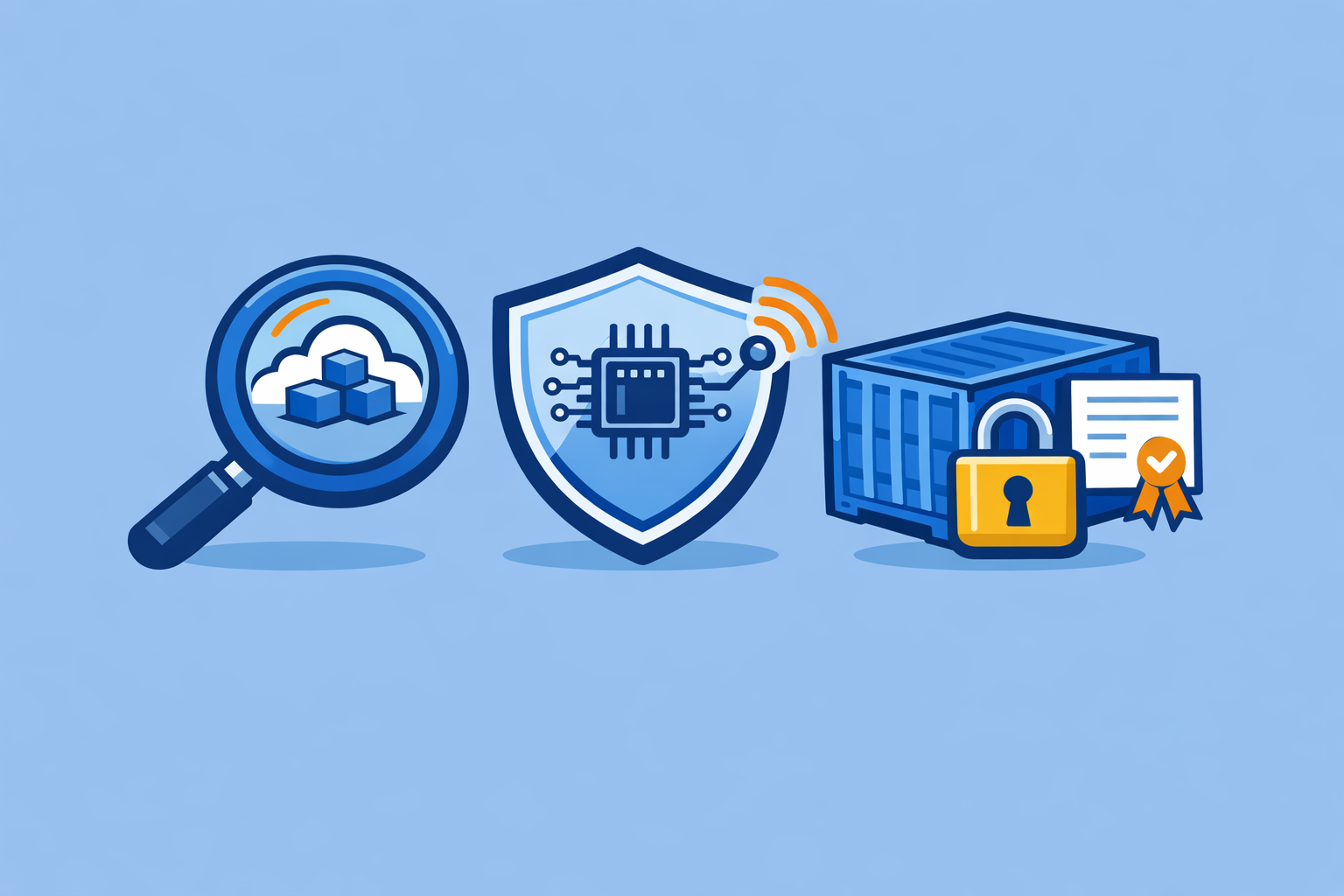
Cloud-based container security solutions ship in three deployment architectures: agentless, sensor-based, and catalog-based. Each maps to a different stage in the workload lifecycle and a different set of compliance controls.
Agentless (API-Driven Scanning of Images and Kubernetes API Objects)
Agentless tools authenticate to cloud accounts and Kubernetes clusters using read-only IAM roles, then scan image layers, registry metadata, and the Kubernetes audit log. There is no DaemonSet, no kernel module, no node footprint. Onboarding completes in hours.
Sensor-Based (DaemonSet, eBPF, or Kernel-Module Agents)
Sensor-based tools deploy as a DaemonSet that hooks the kernel via eBPF, a kernel module, or LSM hooks. They observe syscalls, network sockets, file writes, and process trees as they happen. This is the only architecture that can detect a live container escape mapped to MITRE ATT&CK for Containers technique T1611 (Escape to Host) while it is happening.
Catalog-Based (Hardened Images Delivered Via the Registry)
Catalog-based solutions are the prevention layer. They publish minimal container images built from upstream source on a continuous rebuild cadence, with Cosign signatures, CycloneDX-format SBOMs, and Vulnerability Exploitability eXchange (VEX) documents per digest. They do not detect attacks. They eliminate the inherited base-image CVEs that the other two architectures would otherwise re-alert on every scan cycle.
Per NIST SP 800-204C, microservices security explicitly requires reproducible builds, signed provenance, and SBOM coverage, which a catalog architecture produces by default. CIS Kubernetes Benchmark v1.12.0 controls in the 5.x range (network policy, restricted Pod Security Standards) are configuration controls the agentless and sensor architectures enforce, but the benchmark does not produce hardened image content on its own.
3. Best Agentless Cloud-Based Container Security Solutions
The best agentless cloud-based container security solutions in 2026 are Wiz and Orca Security. Both onboard in under a day, scan image registries and Kubernetes API objects via cloud APIs, and produce a unified risk graph that correlates CVEs, misconfigurations, and identity exposures.
Wiz
Wiz uses a side-scanning approach that snapshots block volumes attached to running workloads and analyzes them out of band. It reads the Kubernetes audit log via the cloud provider's API (AWS EKS audit, GCP GKE audit, AKS diagnostic settings) without an agent on the node. The trade-off: Wiz cannot observe live syscalls. It sees state, not behavior.
Orca Security
Orca uses a similar SideScanning architecture, reading workload disks via the cloud control plane. It maps findings to MITRE ATT&CK for Containers and surfaces lateral-movement paths through the cloud-identity graph (overly broad IAM roles, exposed service-account tokens).
Strengths of agentless: zero-friction onboarding, no node CPU footprint, broad cloud coverage. Limitations: no real-time syscall detection, no in-cluster policy enforcement, no way to stop a running container escape. Agentless is excellent posture and inventory, weaker for runtime detection.
4. Best Sensor-Based Cloud-Based Container Security Solutions
Sensor-based cloud-based container security solutions detect runtime threats by hooking the Linux kernel from a per-node DaemonSet. The four most-deployed in 2026 are Sysdig Secure, Aqua Enforcer, SentinelOne Singularity Cloud Security, and CrowdStrike Falcon Cloud Security.
Sysdig Secure
Sysdig is built on Falco's open-source eBPF probe and ships rules mapped to MITRE ATT&CK for Containers. Published p99 CPU overhead falls in the 1% to 3% range on production workloads. Sysdig detects T1611 (Escape to Host) via syscall correlation when a container makes an unexpected setns() or mounts the host filesystem.
Aqua Enforcer
Aqua's Enforcer agent uses a kernel module on Linux nodes plus a Falco-based eBPF mode for newer kernels. It enforces drift prevention, killing any process not present in the original image, and integrates with Aqua's image scanner for build-time CVE data.
SentinelOne Singularity Cloud Security
SentinelOne extends its endpoint sensor architecture to Kubernetes nodes via eBPF. The same agent that runs on EC2 hosts protects pods, with shared detection logic against the same threat model.
CrowdStrike Falcon Cloud Security
CrowdStrike Falcon for containers reuses the Falcon sensor's kernel hooks, adding container-aware metadata to the same telemetry pipeline that protects endpoints. Like SentinelOne, this is an endpoint detection and response (EDR) vendor extending into Kubernetes. The strength is unified detection across endpoints, VMs, and containers.
For deeper background on the kernel mechanisms these sensors hook, see our explainer on container runtimes explained.
Strengths of sensor-based: real-time runtime detection, drift prevention, MITRE ATT&CK coverage. Limitations: per-node CPU overhead, kernel-version compatibility friction, DaemonSet rollout is non-trivial in air-gapped clusters.
5. Best Catalog-Based Cloud-Based Container Security Solutions
Catalog-based cloud-based container security solutions are the prevention layer. They are purely registry-side: a team replaces a public base image with a minimal hardened equivalent, and the CVE backlog drops at the build line instead of being detected by a runtime scanner.
The mechanism is package minimization plus continuous source-built rebuilds. A catalog removes shells, package managers, compilers, and unused libraries from the base layer. Per Chainguard Labs' 2024 State of Hardened Container Images Report (Meyers and Gilbert), popular Debian-based images carry nearly 300 CVEs on average, while minimal hardened equivalents publish single-digit counts. The same pattern holds for Java runtimes, Node.js, Python, and Postgres images on Docker Hub.
A catalog also produces audit evidence that detection-only architectures cannot: SPDX or CycloneDX SBOMs, Cosign signatures verifiable against the Sigstore Rekor transparency log, and VEX documents that flag non-exploitable findings. This is what hardened images foundation covers under NIST SP 800-190 section 4.1.1 (component inventory) and SP 800-53 controls SC-28, SC-39, and CM-6.
A catalog does not detect runtime threats. It does not see lateral movement or live entitlement abuse. It sits underneath the other two architectures and removes the input they would otherwise re-alert on every scan cycle.
6. Best Hybrid Cloud-Based Container Security Solutions (Combining All Three)
The best hybrid cloud-based container security solutions in 2026 are reference architectures, not single products. They combine catalog (prevention), agentless (posture), and sensor (runtime). Each layer answers a different audit question.
| Layer |
What It Does |
Architecture |
Audit Family |
| Catalog |
Eliminates base-image CVEs at build time, produces SBOM and signed provenance |
Registry-side hardened images |
NIST SP 800-53 CM-6, SC-28, SC-39 |
| Agentless |
Inventories workloads, scans cloud config, correlates risk graph |
API-driven snapshot scanner |
NIST SP 800-53 RA-5, CA-7 |
| Sensor |
Detects runtime exploits, drift, and escape attempts |
Per-node eBPF or kernel agent |
NIST SP 800-53 SI-3, SI-4 |
A program that ships only one layer fails one audit family. Combining prevention, posture management, and runtime detection can significantly reduce inherited vulnerability findings while maintaining runtime visibility, although results vary by workload and existing image quality. This is the sequencing that maps to the NIST SP 800-190 alignment for container security programs.
7. The Buyer's Journey: Choosing the Right Solution for Your Stage
The right cloud-based container security solution depends on team size, compliance pressure, and existing tooling. Four common stages cover the path from first production cluster to a measurable program.
Stage 1: Small Team Running Production Containers on EKS, AKS, or GKE
Start with a free-tier agentless scanner (Wiz Cloud Free, Orca Free, or open-source Trivy in CI) and a catalog-based hardened image for the two or three highest-traffic services. Skip the sensor layer until headcount or compliance requires it.
Stage 2: Platform Engineering Org with Multi-Cloud Deployments
Add an agentless CNAPP for unified posture across AWS, Azure, and GCP. Standardize the base image catalog across teams. The sensor layer is optional unless the threat model includes nation-state actors or insider risk.
Stage 3: Enterprise with Regulated Workloads (FedRAMP, FIPS, DoD IL5)
All three architectures are required. Agentless alone leaves runtime gaps that auditors flag under SP 800-53 SI-4. Sensor alone leaves base-image gaps that auditors flag under CM-6 and SC-28. Catalog alone produces no runtime detection. Run all three, and verify the sensor and the catalog ship FIPS 140-3 validated cryptographic modules. The FedRAMP Marketplace lists current authorization status by vendor.
Stage 4: Cyber-Resilient Enterprise with Measurable MTTC and CVE-Reduction KPIs
Track Mean Time to CVE (MTTC) per image line, alert volume per CWPP scanner, and time from CVE disclosure to patch in production. Hardened images cut MTTC from weeks to days at the catalog layer. The sensor catches what gets through.
8. Cloud-Platform Fit for Each Architecture
AWS (ECR, EKS, Fargate, App Runner)
ECR integrates with both agentless scanners (read-only IAM with ecr:GetAuthorizationToken and ecr:BatchGetImage) and catalog mirroring (push hardened images directly to ECR). Fargate restricts kernel access, so sensor agents that depend on kernel modules do not work. eBPF-based sensors with Fargate-compatible builds do.
Azure (ACR, AKS, ACA)
ACR supports image streaming from external catalogs. AKS supports DaemonSets and eBPF on supported Linux node images. Azure Container Apps (ACA) is serverless and excludes node-level sensors.
GCP (Artifact Registry, GKE, Cloud Run)
GKE Autopilot restricts privileged DaemonSets, which limits sensor-based architectures to specific certified vendors. Cloud Run is serverless and excludes node-level sensors entirely. Catalog-based solutions work on all three because they operate at the registry layer.
Multi-Cloud and Air-Gapped Considerations
Self-hosted registries (JFrog Artifactory, Harbor, GitLab Container Registry) are required for air-gapped FedRAMP High and IL5 environments. Catalog-based solutions that publish only to a vendor-hosted registry are blocked there. Agentless tools that depend on a vendor-managed control plane are also blocked. Sensor and catalog architectures with on-prem deployment options carry through.
9. How to Evaluate a Cloud-Based Container Security Solution in 30 Days
A 30-day pilot follows three milestones. Skipping any one of them produces a procurement decision that does not survive the first renewal.
- Day 1, Baseline. Scan three current production images with Trivy or Grype. Record CVE counts by severity. Capture CWPP alert volume per scan cycle.
- Day 5, Architecture Test. Deploy the candidate solution in a staging cluster. Confirm onboarding time, IAM scope, and node CPU overhead (for sensors) match the vendor's published claims.
- Day 30, Proof of Value. Replace one production base image with a hardened equivalent, re-scan, and measure CVE delta. Verify the SBOM signature against Sigstore Rekor. Confirm CWPP alerts on the swapped image dropped.
During a proof of value, compare the same application before and after a base-image replacement using the same scanner, scan date, and advisory feed to measure any reduction in inherited vulnerabilities.
10. Common Procurement Traps for Cloud-Based Container Security Solutions
Three traps account for most failed evaluations.
Buying Agentless Without a Runtime Layer in Regulated Workloads
Many regulated environments implement runtime monitoring to satisfy monitoring and detection requirements, such as those in NIST SP 800-53 SI-4, but the exact implementation depends on the system’s authorization boundary and security architecture.
Stacking Two CNAPPs and Getting 80% Feature Overlap
Wiz plus Prisma Cloud, or Orca plus Microsoft Defender for Cloud, produces overlapping CSPM, CWPP, and CIEM coverage. The same alert fires twice from two consoles. Pick one CNAPP, and add the missing layer (catalog or sensor) separately rather than stacking another posture tool.
Skipping the Catalog Layer
Public base images can inherit a substantial number of vulnerability findings, depending on the image, scanner, advisory feed, architecture, and scan date. Pair a catalog program with the Kyverno admission controller for hardened base images so only signed minimal images deploy to regulated clusters.
How Minimus Delivers the Catalog Architecture
Minimus publishes hardened, minimal container images based on upstream distributions, rebuilt on a continuous cadence to absorb security updates. Each image ships with a Cosign signature, a CycloneDX-style SBOM, VEX-aligned vulnerability-exploitability information, and a published remediation policy targeting critical CVEs within 48 hours of upstream fix availability, with separate timelines for other severity levels as documented in the Trust Center. The catalog covers language runtimes, data stores, ingress components, and FIPS 140-3-ready images built on currently validated cryptographic modules, suitable for FedRAMP Moderate, FedRAMP High, and DoD Impact Level workloads.
Image Creator lets teams build private custom images on the same minimal base when the public catalog does not cover a specific runtime configuration, with Minimus rebuilding those images on the same cadence and SLA as the public catalog. Minimus images are listed in the Iron Bank FedRAMP container images catalog and align with the patterns described in our FedRAMP container compliance guide.
Browse the catalog at images.minimus.io or read the verification, SBOM, and admission-policy guides at docs.minimus.io.
FAQ on Cloud-Based Container Security Solutions
What Are the Best Cloud-Based Container Security Solutions in 2026?
The best cloud-based container security solutions in 2026 split by deployment architecture: agentless (Wiz, Orca Security), sensor-based (Sysdig Secure, Aqua Enforcer, SentinelOne, CrowdStrike Falcon), and catalog-based (hardened image catalogs). Most regulated programs run at least two of the three. A single-vendor purchase typically leaves one audit control family uncovered.
What Is the Difference Between Agentless and Sensor-Based Container Security?
Agentless container security reads cloud APIs and Kubernetes audit logs to scan images and configurations without a DaemonSet on the node. Sensor-based container security deploys per-node agents that hook the Linux kernel via eBPF or kernel modules to detect runtime exploits such as container escape (MITRE ATT&CK T1611). Agentless excels at posture. Sensor-based excels at runtime detection. They cover different control families.
Do I Need a Hardened Image Catalog if I Already Have a CNAPP?
Yes. A CNAPP scans images and parses SBOMs, but it does not rebuild images, remove unused packages, or patch upstream sources. A CNAPP can repeatedly report inherited vulnerabilities present in the selected base image. Replacing the base image with a compatible hardened alternative may reduce those inherited findings substantially.
How Long Does a Cloud-Based Container Security Solution Take to Deploy?
Agentless solutions deploy in hours via read-only IAM roles. Sensor-based solutions deploy in days to weeks because of DaemonSet rollout, kernel-version compatibility, and node-level CPU validation. Catalog-based solutions deploy in days for the first image and scale linearly as more services migrate base layers.
Are Agentless Container Security Solutions Effective for Runtime Detection?
No. Agentless tools see state, not behavior. They detect misconfigurations, exposed credentials, and known vulnerabilities by reading APIs and snapshots. They cannot observe a live syscall, intercept a container escape, or detect an in-memory exploit. For runtime detection in regulated workloads, pair agentless with a sensor-based architecture or accept the SI-4 control gap.












.svg)
.svg)




.svg)



.svg)